
Recycling lithium-ion batteries is essential for sustainability: once they reach the end of their useful life, they must be disposed of correctly. In this sense, there are certain technical aspects to take into account to give a "second life" to this type of storage. We are going to see the keys below, from the difference between physical and chemical processing to the different phases that usually occur in the reuse of batteries.
Recycling processes for battery recovery: physical and chemical processing
Recycling lithium batteries involves various processes to recover battery components and reduce the amount of waste. There are two main types of processes: physical and chemical.
1. Physical processes
Physical processes are a fundamental part of lithium battery recycling, since they are responsible for pre-treatment of the battery components before carrying out the chemical processes. These physical processes are based on the use of different physical characteristics of the materials present in the battery, such as density, magnetic properties and solubility, to separate the cathode and anode materials from other components such as current collectors and electrolytes.
One of the most common physical processes is battery disassembly, where the different components of the battery such as the casing, electrolyte, and current collectors are separated. Once separated, the components are crushed and subjected to a separation process in which flotation, magnetic separation and density separation techniques are used to separate the different materials present in the battery.
In the separation process, battery materials are classified into different fractions based on their physical properties. For example, casing material can be separated using magnetic separation as it is attracted to a magnet, while heavier materials such as current collectors are separated by density.
2. Chemical processes
The chemical processes for recycling lithium batteries are based on the extraction of the active components of the battery through the use of solvents, reagents and acids that allow the separation of the different metals found in the battery, such as lithium, cobalt, nickel, manganese, among others.Hydrometallurgical processes are the most used for recycling lithium batteries due to their selectivity in the recovery of metals and the reduction of toxic gas emissions compared to pyrometallurgical processes. Within hydrometallurgical processes, different techniques are used to recover lithium battery materials. Some of these techniques are acid leaching, solvent extraction, electrodeposition, and chemical precipitation.
Pyrometallurgical processes are one of the most common forms of chemical processing to recycle lithium batteries. In this process, the metal components of the battery are recovered by melting at high temperatures (generally between 800-1300°C), allowing the different metals to melt and separate. Metals are recovered in the form of alloys, such as copper, cobalt, nickel and iron, which can then be refined to obtain high purity metallic components.
This process has the advantage of being relatively simple and productive for the recovery of metallic materials, but is not suitable for the recovery of organic materials. Additionally, the slag resulting from the process can contain a variety of components, including metals and other materials, which can make it difficult to properly dispose of.

_[Fig. A Recycling processes and schemes [1]](__NCP_TOKEN_0__)_
The seven processes to recycle lithium batteries
In order to recycle lithium batteries efficiently and profitably, we propose 7 key phases that adapt to the complexity of the batteries and the recycling strategies of each plant.
- Preselection: In this process, an initial evaluation of the batteries is carried out to determine their condition, size and type. It is also checked for defective or damaged batteries that are not suitable for recycling.
- Energy Recovery: Lithium cells or batteries contain energy and it is important to safely extract it before processing the battery for recycling. This process removes dangerous liquids and gases that can be released when handling the battery.
- Disassembly: In this process the battery is dismantled to separate its components and parts. Most lithium batteries are disassembled manually, but some automated processes are also being developed.- Decontamination: Lithium batteries contain dangerous chemicals, such as acids and heavy metals, which must be treated carefully to prevent their release into the environment. In this process, contaminating materials are removed and the battery parts are decontaminated. It includes cryogenic treatment, around -200°C, which avoids exothermic reactions during the subsequent phases of the recycling process and/or pyrolysis and calcination thermal treatments to eliminate organic and flammable components.
- Release: Once the battery has been disassembled and decontaminated, its components are separated. This process may involve crushing or grinding the battery into small pieces to facilitate separation.
- Separation: In this process, the materials that make up the battery are separated, such as cobalt, nickel, lithium and iron. Physical and chemical processes are used to separate materials and purify them for later use.
- Metallurgical refining: Once the materials are separated, they are refined. This technique can be thermal (pyrometallurgical processes), chemical (hydrometallurgical processes) or even biological (biometallurgical).
Lithium battery materials recovery
If we compare the two lithium battery recycling processes, and analyzing pyrometallurgical vs. hydrometallurgical, what advantages does each one offer?
- Pyrometallurgical methods are more expensive in terms of energy and materials, but produce metals that can be sold.
- Hydrometallurgical methods can obtain high-quality materials for reuse in new batteries, making them potentially more efficient, but they are more complex and require more steps and chemicals.
However, hydrometallurgical methods have a significant advantage in terms of metal recovery. They can recover up to 100% of the lithium and cobalt, 98% of the manganese and 75% of the aluminum in the form of cathode/anode materials ready for use in new batteries. All in all, this depends on whether the recycling process is profitable in terms of costs and revenues.
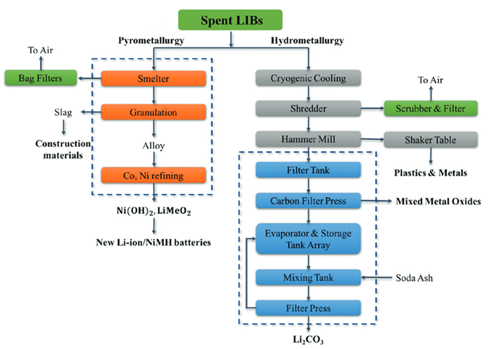
_[Fig. B: Example diagram of pyrometallurgical and hydrometallurgical processes for recycling NiMH, LMO and LCO batteries [2]](__NCP_TOKEN_1__)_
The table below presents several examples of metals and products that can be recovered from end-of-life lithium batteries through different recycling processes. The table also indicates the purity that can be obtained from each of them, which ranges between 90% and 100%.
_[Fig. C: Summary of metals and chemicals obtained from recycling used Libs [3]](__NCP_TOKEN_2__)_The table indicates that it is possible to recover both pure metals (cobalt, nickel, copper) and usable products to produce new cathode materials (carbonates, sulfates and hydroxides of various metals) from spent cathodes in different types of lithium batteries, such as LCO (LiCoO2), LFP (LiFePO4), LMO (LiMn2O4), NMC (LiNi1/3Co1/3Mn1/3O2) and NCA (LiNi0.8Co0.15Al0.05O2), through physicochemical processes.
The recycling process of the future
The recycling process currently used for lithium batteries involves obtaining the basic elements and compounds for the creation of new active materials from a "black mass". This black mass is a pulp of cathode and anode materials that have yet to be refined, resulting in a waste of energy and other materials.
_[Fig. D: Actual recycling process [1]](__NCP_TOKEN_3__)_
In order to improve efficiency, the goal is to switch to a "direct recycling" process. This seeks to directly recycle the active materials as much as possible, avoiding the transformation into black mass and the need for refining and resynthesizing the cathode and anode materials. This process also involves the implementation of collection systems based on the health of the modules and cells, which makes the selection phase easier and faster.
In addition, the mechanical design of the batteries will be carried out taking into account the disassembly that will take place at the end of their life, which will facilitate disassembly in the recycling process. The active materials will be recovered and regenerated to the extent possible, and only the non-regenerable part will undergo transformation into primary components.
Compared to the current process, direct recycling results in greater energy efficiency and significant waste reduction. The regenerated materials can be reused in the new cell production cycle, starting the cycle again.
_[Fig. E: Future recycling process [1]](__NCP_TOKEN_4__ "Fig. E: Futuro proceso de reciclaje [1]")_
To achieve optimal recovery in the recycling process, it is important to accurately select the materials to be recycled and their specific chemistry. To achieve this, it is necessary to improve the traceability of cells through technologies such as tags and RFID, which uniquely identify their composition and life state. However, the recycling process is challenged by steadily decreasing cell costs, requiring more convenient and efficient recycling processes.
Currently, there are different recycling processes specialized in one type of battery to achieve high efficiencies. - Umicore and Sumitomo-Sony processes allow products that can be mixed with virgin materials for use in new batteries without sacrificing their final quality.
- The Recupyl process, in addition to cobalt, allows the recovery of LiFePO 4 cathodes and LiPF 6 electrolyte
- The Umicore-Valéas and Sumitomo-Sony processes fail to recover electrolytes, plastics, organic materials, metals and graphite for direct use but are partially used as by-products for the construction industry, thus devaluing their value.
Currently, recycling of LiFePO 4 and LiMn 2 O 4 batteries is limited due to their low market value, but these chemicals are increasingly being used in the energy industry. As production of LiFePO 4 batteries increases, it is expected that their recycling will also increase and costs will be reduced. In addition, this type of battery is safer than other materials and its use is expected to expand in the future.
_[Fig. F: Battery Chemistry Market Share Forecast, 2015 - 2030 [4]](__NCP_TOKEN_5__)_
Second Life lithium battery: a solution that can be combined with recycling that should not be underestimated
More and more studies talk about giving a second life to lithium batteries that have reached the end of their useful life in electric vehicles. This solution involves recovering and reusing the spent battery for other purposes, such as energy storage, before recycling it.
Reuse extends the overall life of the battery and reduces the environmental impact of production, recycling and disposal. Depending on the type of use, the second life of a battery can last even more than 10 years.
In general, practicing Second Life can extend the overall life of the battery and reduce its environmental impact, but its feasibility depends on the specific application and the uniformity of batteries on the market.
In the automotive sector, batteries are produced in large volumes and are more uniform, making it easier to reuse batteries at the end of their useful life for other purposes.
NCPOWER lithium batteries? Increasingly attentive to the issue of recycling and sustainability
At NCPOWER we focus on sustainability in all aspects of our corporate vision, from the energy efficiency of our plant to the design of our batteries.
The Research and Development department is fundamental in this strategy, not only to anticipate customer needs with innovative products, but also to find more environmentally friendly solutions. NCPOWER uses LFP chemistry in its batteries, which is safe, stable and completely free of cobalt, a material that has a large environmental impact. In addition, the Research and Development department is actively studying more eco-sustainable production processes and materials, to optimize the different production steps and battery design.
We know there is a long way to go, but NCPOWER is confident that investment in materials and skills aimed at efficiency and sustainability can make a major contribution on the path to a green society.
Bibliography
[1] https://battery2030.eu/wp-content/uploads/2022/07/BATTERY-2030-Roadmap_Revision_FINAL.pdf
[2] https://pubs.rsc.org/en/content/articlelanding/2018/cs /c8cs00297e/
[3] https://doi.org/10.1016/j.jpowsour.2018.07.116
[4] Wood Mackenzie Energy Storage Service