
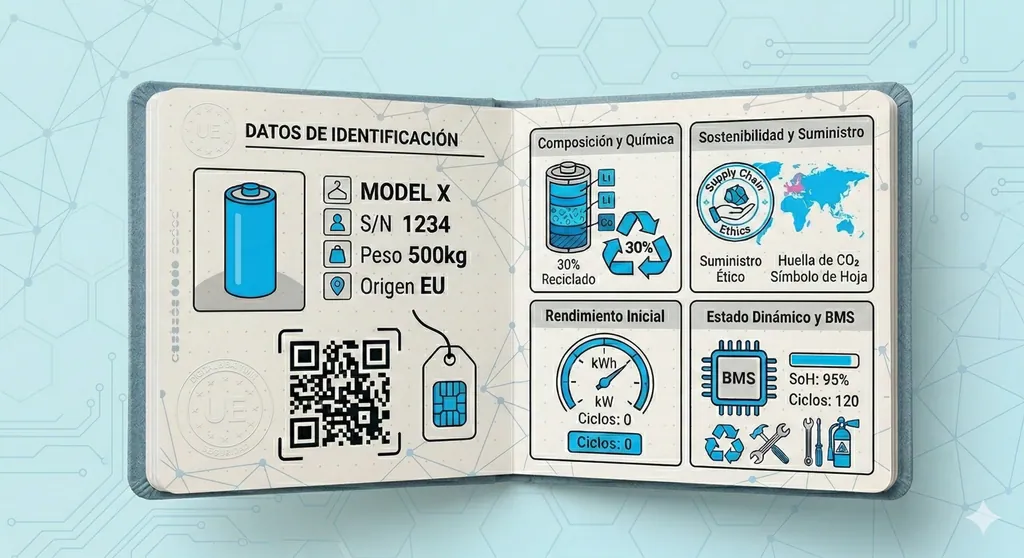
For all members of the industry, one of the most important technological and regulatory developments is the implementation of the Digital Passport for Batteries (_Battery Passport_). In this technical guide, we offer a detailed analysis of the fundamental requirements and the schedule of key milestones dictated by the regulations, to understand their scope and the critical steps for their compliance.
The transition towards a circular and sustainable economy requires unprecedented traceability. With the entry into force of Regulation (EU) 2023/1542, the European Union redefines the sustainability, safety and life cycle standards of energy storage systems.
Official source: https://www.boe.es/buscar/doc.php?id=DOUE-L-2023-81096
1. What is the Digital Passport for Batteries? (Art. 77)
The “Battery Passport” is the equivalent of the "DNI" of the battery. This is an individualized electronic record that will accompany each battery throughout its useful life. Its main objective is to maximize transparency, facilitate the circular economy (repair, second life and recycling) and ensure that all actors in the value chain have access to relevant information in a secure and interoperable manner.
What does it consist of and what data does it include?
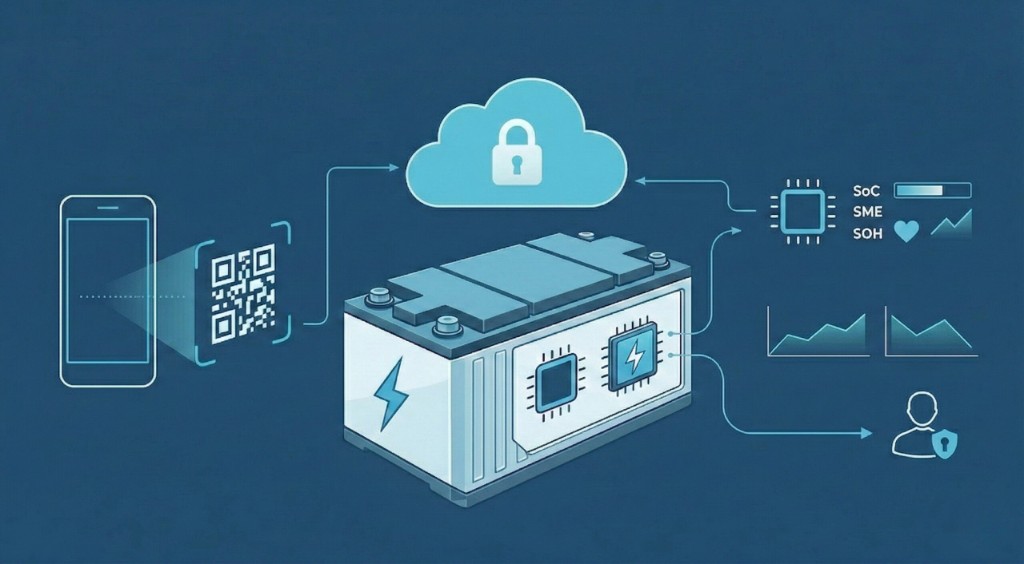
Conceptually, the passport is not a simple PDF document, but rather a series of data that is referenced in a standardized way. Physically, the user interacts with the passport through scanning a physical QR code implemented on the battery.
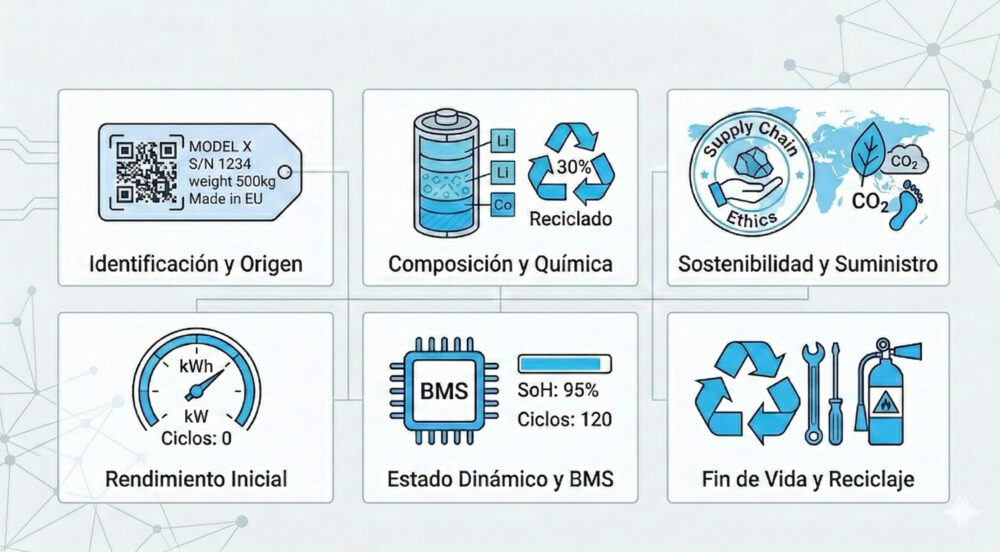
In accordance with the Regulation and its corresponding Annexes, this registry will consolidate a large amount of data, organized into the following main categories:
- General and Identification Data: Manufacturer information, production facility, manufacturing date, weight, model and the exact category to which the battery belongs.
- Composition and Chemistry: Detailed specification of the materials and cellular chemistry used (e.g. LFP, NMC, etc.), paying special attention to critical raw materials (lithium, cobalt, nickel) and declaring the exact proportions of recycled materials incorporated.
- Sustainability and Supply Chain: Documentation on due diligence policies that guarantee the ethical extraction of minerals, as well as the official declaration of the total carbon footprint generated during the manufacturing of the product.
- Initial Performance and Durability: Nominal factory parameters such as energy storage capacity, voltage, power, and estimated useful life in cycles or years according to laboratory tests.- Dynamic Data and Current Status: As the battery is used, the passport will link to live information from the BMS, reflecting the current Health Status, charge/discharge cycle counter and other metrics that demonstrate its actual wear in the physical world.
- End of Life Management: Detailed technical instructions, CAD drawings, specific safety measures, and disassembly and fire extinguishing protocols. This is critical so that recycling or adaptation companies can operate on the battery pack without risks.
Scope of Application and Key Date
Not all batteries are subject to this obligation immediately. According to Article 77, the Passport will be mandatory from February 18, 2027 for the following categories introduced on the market or put into service:
- Batteries for light means of transport (LMT): (e.g. scooters and electric bicycles).
- Industrial batteries: Exclusively those with a capacity greater than 2 kWh.
- Batteries for electric vehicles (EV).
2. The Data Ecosystem: Tagging, BMS and the Physical-Digital Bridge
For the _Battery Passport_ to work, it requires a series of physical and logical characteristics in the battery itself. Here articles 13 and 14 of the Regulations come into play:
Article 13: Labeling, Marking and the QR Code
Article 13 sets out how the physical battery connects to its digital ecosystem. Requires that batteries carry clear labels with basic information (manufacturer, battery type, chemistry, etc.) and, most importantly, a highly visible and durable QR code. This QR code is the universal “gateway” to the Battery Passport, linking the physical hardware to the cloud-hosted database.
Article 14: The Battery Management System (BMS)
Passport information is not only static, it is also dynamic. Article 14 requires stationary battery energy storage systems, LMT batteries and EV batteries to include a BMS (Battery Management System) capable of calculating and storing data on State of Health and expected useful life. Access to this data in the BMS must be possible for the end user or a third party acting on their behalf, ensuring that the passport reflects the actual wear of the battery and assesses its suitability for potential reuse.
3. The Carbon Footprint and Sustainability (Annex III)One of the pillars of the new Regulation is to ensure that battery manufacturing does not displace the environmental impact of fossil fuels to the industrial supply chain.
Annex III defines the essential parameters and methodologies to calculate the Carbon Footprint of the battery, from the extraction of raw materials (lithium, cobalt, nickel mining) to the end of its useful life. This carbon footprint declaration must include:
- Information about the manufacturer and the production plant.
- Battery category.
- GHG (Greenhouse Gas) emissions values.
- A web link to a public study that supports the declared values.
All of this information originating under Annex III is a mandatory component of the _Battery Passport_ public layer.
4. Information Architecture and Access Levels (Annex XIII)
As we have previously commented in relation to Article 14, the _Battery Passport_ is not a static document, but a dynamic database structured at different levels of confidentiality. Annex XIII exhaustively details what information must be included and the Regulation establishes a role-based access system to protect intellectual property:
A. Public Information
It includes sustainability data (such as Annex III carbon footprint), responsible sourcing of raw materials, percentage of recycled content, general model characteristics and user manuals.
B. Institutional Access (Notified Bodies and Authorities)
Reserved for market surveillance authorities and the European Commission. Includes test reports, safety test results, and technical documentation for audits and compliance verification.
C. Access for Legitimate Interest (Value Chain Actors)
Highly technical information accessible only to natural or legal persons who need this data for their economic activities:
- Disassembly and safety instructions: Essential to prevent thermal or electrical accidents.
- Detailed composition: Vital for repairers, manufacturers of remanufactured products and recyclers.
- Health status and integration: The data extracted from the BMS (Art. 14) is key to evaluating the technical feasibility of a battery for second life or V2G applications.
5. Technical and Technological Requirements (Article 78)
The implementation of the _Battery Passport_ requires a computer deployment that must comply with strict essential design and operation requirements:1. Interoperability and Open Standards: Data cannot be in closed ecosystems. They must be based on open standards, be machine readable, structured and transferable through interoperable networks.
3. Unique Identifier: The QR code will link to an identifier governed by international regulations ISO/IEC 15459 (parts 1 to 6).
5. Security and Privacy: The system must guarantee authentication, reliability, data integrity and have robust mechanisms against cyber fraud.
7. Storage and Permanence: The information must be stored by the economic operator (or an authorized third party). Crucially, the passport must remain available even if the manufacturing company goes out of business or disappears.
6. Life Cycle and Extended Responsibility
The _Battery Passport_ is a living document that evolves with the product:
- Data Maintenance: The economic operator that introduces the battery to the market is responsible for the accuracy of the information.
- Second Life and Remanufacturing: If a battery is subjected to preparation for reuse or adaptation, a new passport linked to the original passport must be generated to maintain historical traceability.
- End of Life: When the battery is declared waste, the responsibility of the passport is transferred to the Extended Producer Responsibility Organization (SCRAP/PRO) or the waste manager. The Passport will permanently cease to exist only once the battery has been completely recycled.
7. Implementation Timeline: Key Milestones of the Regulation
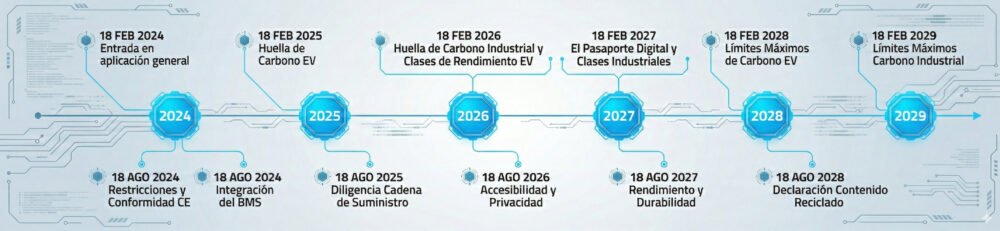
To facilitate the adaptation of the industry, Regulation (EU) 2023/1542 establishes a progressive application of the technological and traceability requirements that will inform the _Battery Passport_. The regulatory deadlines verified in the official text are detailed below, including all the milestones of the regulation to offer a complete historical and prospective view:
- February 18, 2024: Entry into general application of the Battery Regulation throughout the European Union.
- August 18, 2024 (Restrictions on Hazardous Substances and CE Compliance): Entry into force of Articles 6 and 18. Severe restrictions apply on the use of mercury, cadmium and lead. In addition, it is established that regulatory compliance and correct data traceability are binding and essential requirements to obtain the CE Marking and be able to market the battery.- August 18, 2024 (Integration of the BMS): Implementation of Article 14. Mandatory to integrate the Battery Management System with the capacity to determine the State of Health in stationary, LMT and EV batteries.
- February 18, 2025 (EV Carbon Footprint): Mandatory requirement to have a documented carbon footprint declaration (Annex III) for electric vehicle (EV) batteries.
- August 18, 2025 (Supply Chain Due Diligence): Entry into force of Article 48. Operators must verify and document the ethical and sustainable origin of raw materials.
- February 18, 2026 (Industrial Carbon Footprint and EV Performance Classes): Mandatory carbon footprint declaration for rechargeable industrial batteries. In addition, the obligation to classify EV batteries into carbon footprint "performance classes" comes into force (Art. 7).
- August 18, 2026 (Accessibility and Privacy): Deadline (Art. 77.9) for the European Commission to adopt the implementing acts that will specify exactly which actors are considered persons with "legitimate interest" and what specific data they will have access to in the passport.
- February 18, 2027 (The Digital Passport and Industrial Classes): Entry into force of Article 77.1. All LMT, industrial (> 2 kWh) and EV batteries must have an active electronic registration (Battery Passport) accessible through their QR Code. At the same time, it will be mandatory to classify industrial batteries into carbon footprint performance classes.
- August 18, 2027 (Performance and Durability): Application of the electrochemical performance and durability requirements (Art. 10) for industrial batteries (> 2 kWh), establishing the minimum legal thresholds that will be part of the static parameters of the passport.
- February 18, 2028 (Maximum EV Carbon Limits): Entry into force of the maximum permitted thresholds of the carbon footprint life cycle for EV batteries (those that exceed them will not be able to be marketed).
- August 18, 2028 (Declaration of Recycled Content): Obligation to include in the technical documentation and in the passport the declaration of the exact proportion of cobalt, lead, lithium and nickel recovered from waste and present in the active materials of the battery (Art. 8).
- February 18, 2029 (Maximum Industrial Carbon Limits): Entry into force of the maximum permitted thresholds of the carbon footprint life cycle for industrial batteries.
8. The NCPower CommitmentFor NCPower, the horizon of 2027 is not a limit, but a starting point. As a company that is strongly committed to the quality of after-sales service and transparency in the management of its products, we do not see this change as a simple legal obligation, but as the quality standard that the market deserves. The value of a lithium battery will no longer reside solely in the energy it is capable of storing, but in the transparency and quality of its data, its verifiable durability and its ability to be recycled.
At our company, we are actively working on the integration of traceability platforms based on open standards to ensure that our batteries not only offer maximum performance and safety, but are 100% compliant with European regulations, driving a truly circular and intelligent energy future.
If you want to delve deeper into our work methodology, transparency and after-sales quality, do not hesitate to contact us.
Contact us