
When the certification of a product such as a lithium battery is addressed, one of the first conclusions drawn is that Europe and the United States not only apply different standards, but also start from completely different regulatory models.
In Europe, the system is based on a centralized framework where the European Parliament and the Council of the European Union approve directives and regulations, while the European Commission is responsible for their development and supervision. This system is based on harmonized standards developed by organizations such as CEN (European Committee for Standardization) and CENELEC (European Committee for Electrotechnical Standardization), which allow the manufacturer to demonstrate compliance with the essential requirements and, consequently, issue the CE Marking as evidence of conformity of the product before its marketing.
In the United States, however, there is no direct equivalent to the CE Marking. The United States Congress passes federal laws that do not directly define technical requirements, but instead grant authority to different specialized agencies depending on the scope of application. These agencies develop their own regulations, which are subsequently compiled in the Code of Federal Regulations (CFR), a kind of large structured library where the technical regulations in force at the federal level are collected.
1. Definition of the Operational and Regulatory Scenario
The US model is defined as sectoral and decentralized, since there is no single authority or framework applicable to all products. While in Europe the process consists of identifying which directives or regulations affect the product, in the United States the approach changes completely: the manufacturer must identify which agencies have jurisdiction over their product and, from there, which parts of the CFR and which technical standards are applicable. Furthermore, the system is predominantly reactive, in the sense that in many cases there is no widespread prior approval before marketing, but rather the responsibility for compliance falls squarely on the manufacturer.
The first step is the analysis of the application context, since a battery intended for a registered vehicle, industrial equipment or a stationary installation is not the same. This initial analysis is key, as it determines which federal agencies come into play:
- NHTSA (National Highway Traffic Safety Administration): Regulates safety requirements in registered vehicles and operates under a self-certification model by the manufacturer.- OSHA (Occupational Safety and Health Administration): It is the federal agency in charge of guaranteeing safe and healthy working conditions. In the context of batteries, OSHA rigorously regulates the use of electrical equipment in the work environment and in industrial vehicles, requiring that energy storage systems be evaluated and approved to prevent electrical, chemical or fire hazards that could endanger workers.
- DOT (Department of Transportation): It is the highest authority in transportation. Within this department, the PHMSA (Pipeline and Hazardous Materials Safety Administration) is the specific agency that dictates and enforces regulations for the transportation of dangerous goods, including lithium batteries.
- FCC (Federal Communications Commission): It comes into play if the product incorporates electronics that can emit radio frequency.
2. Breakdown of the Applicable Regulatory Framework in the United States
To market a battery safely on US soil, it is necessary to know the multidisciplinary ecosystem of laws aimed at protecting users and the environment, based on the following regulatory frameworks:
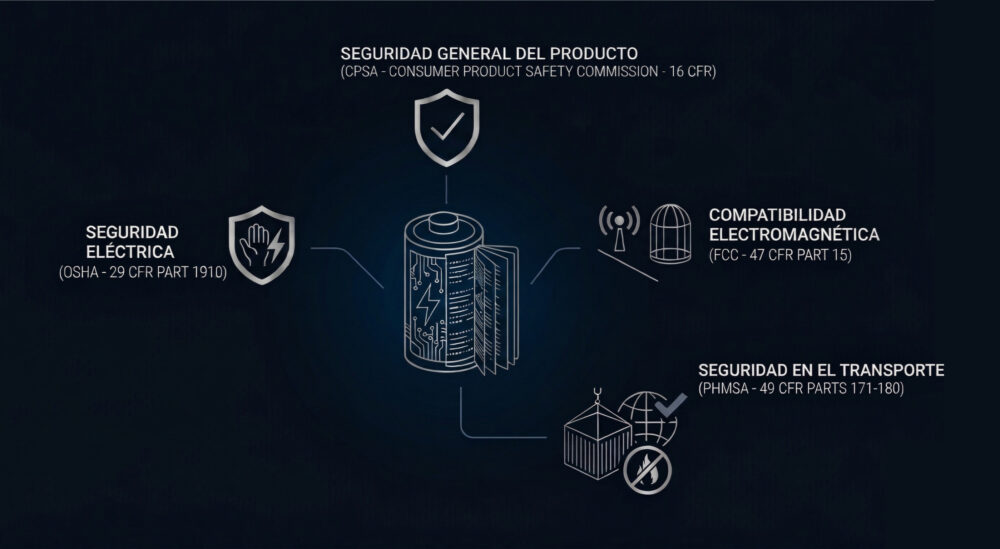
- General Product Safety (Consumer Product Safety Commission - 16 CFR): Under the _Consumer Product Safety Act_ _(CPSA)_, federal law prohibits the marketing of products that present unreasonable risks of harm, such as fire or explosion. The regulation requires the manufacturer to immediately report any material defect detected, even if the finding occurs in markets outside the US.
- Electrical Safety (OSHA- 29 CFR Part 1910): Specifically, section 1910.303 requires that electrical equipment used in the workplace be approved, and the definition of this concept in 1910.399 states that, in practice, this approval usually implies that the product has been evaluated by a laboratory recognized in accordance with 1910.7, known as NRTL (Nationally Recognized Testing Laboratory). It is important to understand that NRTL are not a universal marketing requirement in the United States, but rather a specific mechanism linked to the scope of OSHA. It is precisely these laboratories that are in charge of evaluating products and granting certifications under standards such as UL 1973 (stationary and auxiliary power applications), UL 2580 (industrial vehicles) or UL 2271 (light electric vehicles). It should be noted that these regulations are not part of the CFR, but rather act as the technical standards that these laboratories use to grant their safety seal.- Electromagnetic compatibility (FCC- 47 CFR Part 15): In this area, regulation falls on the FCC. Unlike other areas, there may be a premarket authorization requirement here depending on the type of device. Test standards such as ANSI C63.4 or ANSI C63.10, developed under the ANSI framework, are used to demonstrate compliance. Unlike UL, ANSI does not certify products, but rather accredits standards that are later used as a reference in testing.
- Transportation security (PHMSA- 49 CFR Parts 171-180): In this case, compliance, regulated by the PHMSA, is based on passing the tests defined in the _UN_ _Manual of Tests and Criteria, Part III, subsection 38.3_. This requirement is independent of the final use of the product and applies whenever the battery is transported as dangerous goods. The Hazardous Materials Regulations (HMR) legally classify lithium batteries as dangerous goods (UN3480/UN3481). Title 49 CFR dictates rules for physical security, packaging, and the requirement to visibly display the power capacity in watt-hours (Wh) on the enclosure.
3. Validation through Tests and Technical Requirements
NCPower translates the above legal framework into physical evidence and technical protocols before the launch of each product. Our approach is based on validating compliance in a modular way, combining the requirements of different agencies based on the use, transportation and functionality of the equipment:
- Transportation Security (PHMSA - 49 CFR): We strictly and obligatorily comply with transportation regulations by passing the tests defined in the _UN Manual of Tests and Criteria, Part III, subsection 38.3_. This ensures that our batteries, legally classified as dangerous goods (UN3480/UN3481), comply with physical security, packaging and energy capacity marking rules.
- Electrical Safety and Evaluation (OSHA - 29 CFR and UL Standards): To ensure a safe environment and support that electrical equipment is approved according to section 1910.303, we rely on comprehensive safety evaluations. We apply and comply with the industry technical standards used by the NRTL laboratories mentioned above, such as UL 2580 and UL 2271 (commercial vehicles and light electric vehicles).- Electromagnetic Compatibility (FCC - 47 CFR): For those batteries that incorporate electronics capable of emitting radio frequency, we guarantee compliance under the jurisdiction of the FCC. We use previous testing standards (ANSI C63.4 or ANSI C63.10) to demonstrate the technical compliance of our components before they are placed on the market.
- General Product Safety (CPSC - 16 CFR): We design our batteries to avoid any unreasonable risk of damage, preventing critical scenarios such as fires or explosions under the requirements of the _Consumer Product Safety Act_. Our accountability system allows us to demonstrate the continued safety of our product.
4. Our Quality Philosophy does not change: NCPower's DNA
Although, as we have commented in the previous sections, the American system is a reactive system that differs from the prevention and mandatory nature of the European system, at NCPower we apply the same quality philosophy, taking care of every detail and ensuring the safety and trust of our Partners.
Regardless of where our batteries are going to be marketed, we consider it non-negotiable to comply with the most demanding regulations. This level of compliance is not an isolated effort, but the natural result of a daily work methodology based on attention to detail.
This vision is technologically materialized through the NCPower System, a comprehensive control and safety architecture designed to overcome the limitations of conventional battery management systems (BMS), eliminating thermal stress and allowing intelligent external balancing that maximizes the durability and efficiency of the pack. In turn, this entire methodology is supported by our Quality Management System, certified by Bureau Veritas under the ISO 9001 standard, which allows us to guarantee that each process, from the initial design to the final support, follows the most rigorous international standards.
5. Legal Security and Technical Excellence in Each Delivery
Although following a different homologation process than the European one, our quality methodology also results in the Technical Quality File, an exclusive document for each model that acts as the definitive seal of conformity. This file is the physical evidence that we provide to our clients to guarantee that their investment meets all the safety, quality and sustainability requirements required by the various US regulations.The greatest support for our quality methodology comes from the trust we generate in our Partners. Managers and managers highlight the peace of mind of having an asset designed to protect its profitability and operate without risks. For them, we do not limit ourselves to delivering a battery, they see us as a partner that provides a quality product for the safe continuity of their operations.
If you want to know more about how at NCPower we guarantee the safety and quality of our batteries regardless of the marketing area, do not hesitate to contact our team.
Contact us