

Talking about lithium batteries often goes hand in hand with the abbreviation BMS, which refers to the battery management system in English. Despite its importance, many people are unaware of its function and meaning. In this article we will explain what the BMS is in lithium batteries and what its function is in cell balancing.
What is a lithium battery BMS?
The importance of this system in cell balancing
Although lithium batteries offer many advantages compared to traditional batteries thanks to their high performance, they also have a weak point. Which is it? The difficulty of balancing cells and ensuring uniformity of energy production from one cell to another.
This can mean differences in three aspects:
- Nominal capacity
- Internal resistance
- Self-discharge
Over time or with use itself, these differences can unbalance the cells within the battery, generating a discrepancy of between 3% and 6% depending on the conditions of use and the charge/use cycles of the lithium battery.
When a lithium battery becomes unbalanced, it means that the cells that make it up do not have the same charge or state of charge. This can cause some cells to discharge faster than others, which can reduce the overall capacity of the battery, decrease its performance, and shorten its life. Without a proper cell balancing system, the difference between the cells can increase more and more, gradually exhausting the available charge capacity. It can also cause damage to the battery or even cause dangerous situations, such as a fire or explosion, especially if the battery is subjected to very intense charging and discharging. Therefore, it is important to have a proper balancing system that keeps the battery balanced and in good condition to ensure its efficiency and safety.
Because the cells within a lithium battery are connected in series, they all charge and discharge at the same energy level. However, if a proper cell balancing system is not available, the differences between cells can increase over time, gradually decreasing the total capacity of the battery. Therefore, the first function of a BMS in a lithium-ion battery is cell balancing.
Lithium Ion Batteries: BMS and Cell Balancing
How does a conventional BMS affect balance?
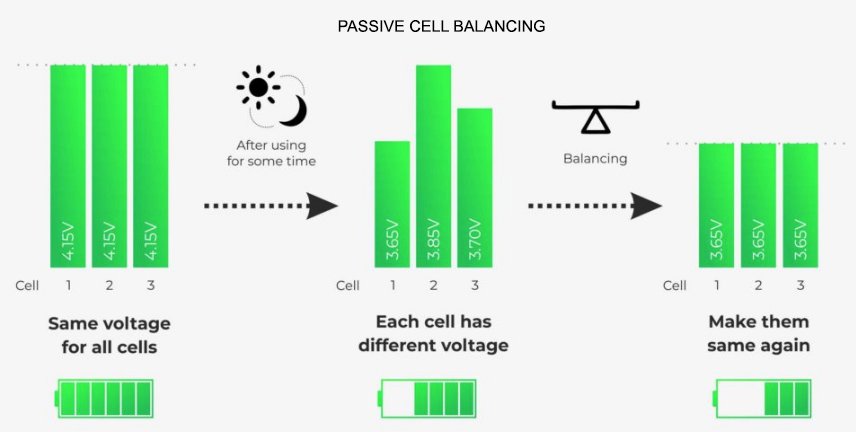
A typical BMS addresses the imbalance by applying resistance to the cells with a higher charge, until the weaker cells reach that same level.
Let's look at the pros and cons of using this technology:
PROS- Using common BMS is cost-effective: thanks to its simple architecture, it helps keep the cost of electronics low.
CONS
- Extremely slow during balance.
The balancing process with a conventional system is extremely slow due to the low current applied (typically between 0.1 A and 1 A), which implies a balancing time of between 6 and 12 hours. For example, on a 400 Ah battery, after 300 Ah has been used, a 100 A battery charger would take 3 hours to restore power, but an additional 6 to 12 hours would be needed to balance it. This results in a total charging time of 9 to 15 hours.
- Gradual reduction of available energy
Continued use of the battery before completing the balancing process may gradually increase the difference between the most charged cell and the least charged cell, thereby decreasing the nominal capacity of the pack. This can lead to a decrease in the performance of vehicles with such lithium batteries, since the cell with the lowest charge limits the discharge and the cell with the highest charge limits the charge.
- High maintenance costs
Maintaining batteries with conventional BMS can be expensive as individual cells cannot be replaced on site, often resulting in the need to ship the battery back to the manufacturer, involving high shipping costs.
How does NCPOWER's patent-pending balancing system work?
We'll start by explaining the difference between active and passive balancing, two different techniques for balancing the cells of a lithium-ion battery.
Passive balancing occurs naturally when a battery is connected in series. Cells with a higher charge transfer excess energy to cells with a lower charge until all cells are balanced. This process is slow and can take a long time.
On the other hand, active balancing is achieved through the use of electronic circuits that monitor the voltage of each cell and transfer energy from the most charged cells to the least charged cells, achieving balance more quickly.
Active balancing is more effective and faster than passive balancing and is used in more advanced battery management systems.
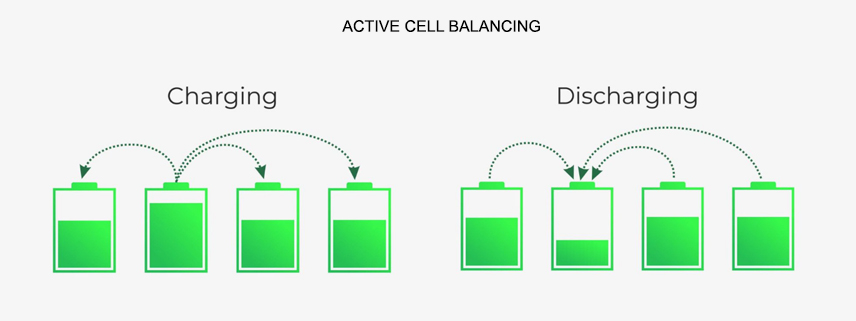
Our battery balancing system, called NCPOWER System, is different from a traditional BMS, as it has the ability to balance each cell individually through combined active and passive balancing, using at least 20 times greater current.
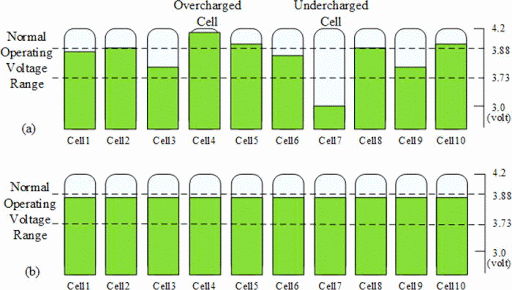
Figure 1: Imbalance and cellular balance
PROS- High power active and passive balancing (20A)
- Short charging time and predictable (balance time less than 25 minutes)
- Active support for weaker cells during discharge
- Complete temperature control, with 2 sensors in each cell (50 sensors in an 80V battery)
CONS
- Applicable only in batteries of 5kWh and above, because the electronics are more expensive in this case.
Other functions of a BMS in lithium batteries
Up to this point we have been able to see the main function of a BMS, the crucial role it has and the difference between the conventional one and that of NCPOWER.
However, there are even more functions that this type of system performs and that are key for lithium batteries. You can see all this in depth here.