
Every time an e-scooter or an electric car catches fire, the story goes viral. It makes sense that anyone thinking about moving a forklift fleet, AGVs or electric vehicles to lithium wonders whether they are bringing a new risk into their facility. The short answer: the risk exists, it is low and measurable, and it depends far more on how the battery is designed and controlled than on the simple fact that it is lithium.
In this article we put data on the table, explain why not all lithium chemistries behave the same, and separate two ideas that are often mixed up: proactive safety, which stops the problem from starting, and reactive safety, which acts if it starts anyway. At the end you can download the datasheet of the fire suppression system that comes as standard on every NCPower battery.
What the data says
Lithium battery fires make the news precisely because they are rare. Three references help put them in perspective:
- Vehicles. In Sweden, the Civil Contingencies Agency (MSB) recorded about 23 fires in 2022 across a fleet of some 611,000 electric and plug-in hybrid cars, against about 3,400 in 4.4 million petrol and diesel cars. That is roughly 4 fires per 100,000 electric vehicles versus about 77 per 100,000 combustion vehicles: around 20 times fewer (The Driven, with MSB data).
- Cells. Internal cell failures are very rare. For commercial cells screened for space use, the field failure rate has been estimated at 1 in 235 million, and in consumer applications experienced manufacturers report 1 to 10 cases per million (NREL and NASA, 2015).
- Stationary storage. The incident rate per installed GWh of battery systems fell 98% between 2018 and 2025 according to EPRI, and their annual failure rate (0.04–0.14%) is comparable to that of an oil-filled transformer (Utility Dive, with EPRI data).
The most useful finding for an industrial user is the last nuance in those studies: most incidents do not start in the cell, but in integration, assembly and control systems (Utility Dive, EPRI, PNNL and TWAICE study). In other words, safety is decided by how the battery is designed, assembled and monitored.
And it is worth remembering the starting point. The lead-acid batteries that lithium replaces are not harmless either: they give off hydrogen while charging, which is why charging rooms need dedicated ventilation. Switching technology does not mean going from zero risk to some risk; it means trading a known risk for a different one, managed in a different way.
Not all lithium is the same: LFP vs NMC
"Lithium battery" is a family name, not a specific chemistry. Phones, e-scooters and many cars use nickel-manganese-cobalt (NMC) cathodes. In industrial equipment, and in every NCPower battery, we use lithium iron phosphate (LiFePO₄ or LFP), the most thermally stable chemistry produced at scale today.
The difference lies in the cathode structure. In LFP, oxygen is tightly bound to the phosphate and is barely released when heated. In NMC, the cathode releases oxygen at high temperature, and that oxygen feeds combustion from inside the cell itself. Test results reflect this:
| Parameter (cell vs graphite) | LFP | NMC |
|---|---|---|
| Self-heating onset | 150–170 °C | 90–110 °C |
| Critical self-heating | 230–260 °C | 170–190 °C |
| Energy released in thermal runaway | 10–15 kJ/Ah | 20–25 kJ/Ah |
| Peak cell-face temperature | ~620 °C | ~800 °C |
| Mass ejected during venting | 20–25% | 40–50% |
Sources: first three rows, Battery Design, with Akkuracy calorimetry; last two, Aspen Aerogels in Electric and Hybrid Vehicle Technology, 2025. These are indicative test values; every specific cell has its own.
In practice, an LFP cell needs around 60–80 °C more before it starts to run away, releases roughly half the energy when it does, and when it vents it tends to release gas and smoke rather than flame. That does not make it impossible to ignite, but it gives control systems much more margin to act first.
How a battery fire starts
Almost every lithium battery fire goes through the same phenomenon: thermal runaway. A cell heats up, that heat triggers internal reactions that generate more heat, and the process feeds itself until the cell vents gas and, in the worst case, ignites. If the heat spreads to neighbouring cells, the problem propagates.
The key point is that thermal runaway almost never comes out of nowhere. It has known triggers:
1. Overcharge. Charging a cell above its maximum voltage degrades the cathode and the electrolyte.
2. Deep discharge. Going below the minimum voltage dissolves the copper current collector, which can later form internal bridges.
3. External short circuit or currents far above design values, which heat connections and cells.
4. Out-of-range temperature. Excess heat speeds up degradation. Cold is dangerous too: charging below 0 °C deposits metallic lithium on the anode (lithium plating), which over time can pierce the separator. We cover this in detail in our article on lithium battery cold weather charging.
5. Mechanical damage: impacts, crushing or vibration not properly handled in the enclosure design.
6. Internal manufacturing defects, the only trigger that does not depend on use, and the rarest of all.
Five of those six triggers are operating conditions: voltage, current, temperature and mechanical handling. They can be measured and, therefore, prevented. That is the job of the first safety layer.
Proactive safety: the BMS and the controls that prevent failure
Proactive safety is everything that keeps a cell from reaching the conditions above. Its core is the BMS (Battery Management System), the electronics inside the battery that monitor it continuously while it works, charges or sits idle. If you want to go deeper, we explain it in what a BMS is and how it extends battery life.
A well-designed BMS does four things:
| Function | What it measures or controls | Risk it prevents |
|---|---|---|
| Voltage protection | The voltage of every cell, not just the pack | Overcharge and deep discharge |
| Current protection | Charge and discharge current, and short circuits | Overcurrent heating |
| Thermal protection | Several temperature sensors spread across the pack | Working or charging when too hot or too cold |
| Balancing and diagnostics | Differences between cells, state of charge and state of health | Cells drifting and ageing faster than the rest |
When any of those values goes out of range, the BMS warns first (it limits power or sends an alarm to the machine) and, if the situation is not corrected, it opens the circuit and disconnects the battery. Many problems are stopped right there, minutes or hours before there is any real risk.
The BMS does not work alone. Proactive safety also includes:
- The chemistry, which in our case is LFP and gives a wider thermal margin, as we have seen.
- The mechanical design of the enclosure: cell fixing, insulation and resistance to vibration and impact.
- Communication with the machine and the charger over CAN bus, so the forklift, the AGV or the charger adapts its behaviour to what the battery reports.
- Thermal management in cold environments, with heating pads that bring cells up to temperature before charging.
- Remote monitoring, which shows trends (a cell drifting out of balance, a temperature creeping up week after week) and lets you act before a failure occurs.
- Certification. Standards such as UN 38.3 (transport tests: vibration, impact, short circuit, overcharge…) and IEC 62619 (safety of industrial lithium batteries, including a thermal runaway propagation test) require proof in the lab that the battery withstands abuse without causing a fire.
Reactive safety: automatic aerosol fire suppression
However well the proactive layer works, no serious engineer designs on the assumption that nothing will ever fail. An internal cell defect, a heavy impact or an external fire reaching the battery are unlikely scenarios, but possible ones. Reactive safety exists for that case: if fire appears inside the enclosure anyway, act within seconds, right where it starts, without relying on anyone being nearby.
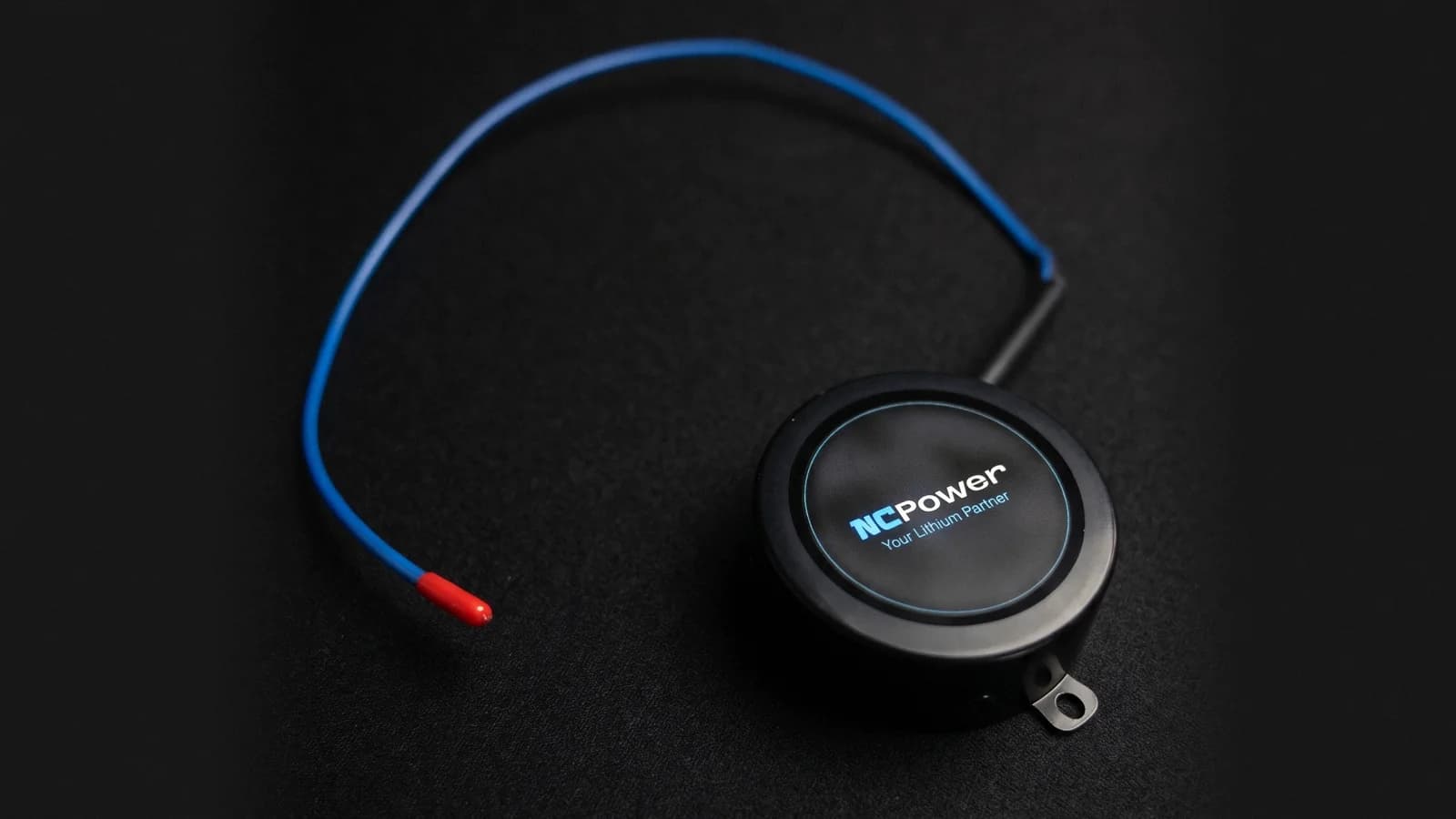
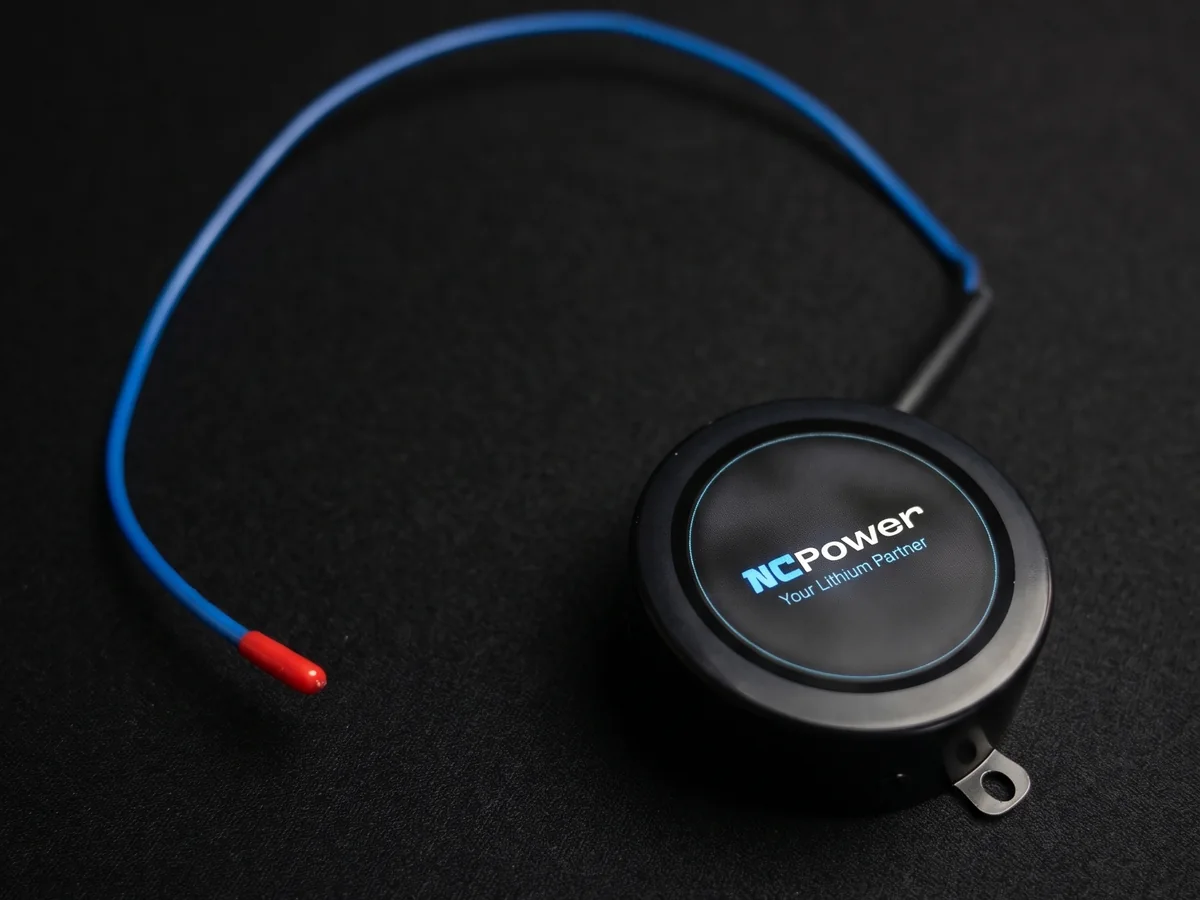
That is why every NCPower battery comes as standard with an automatic condensed-aerosol fire suppression system installed inside the enclosure.
What it is and where it goes
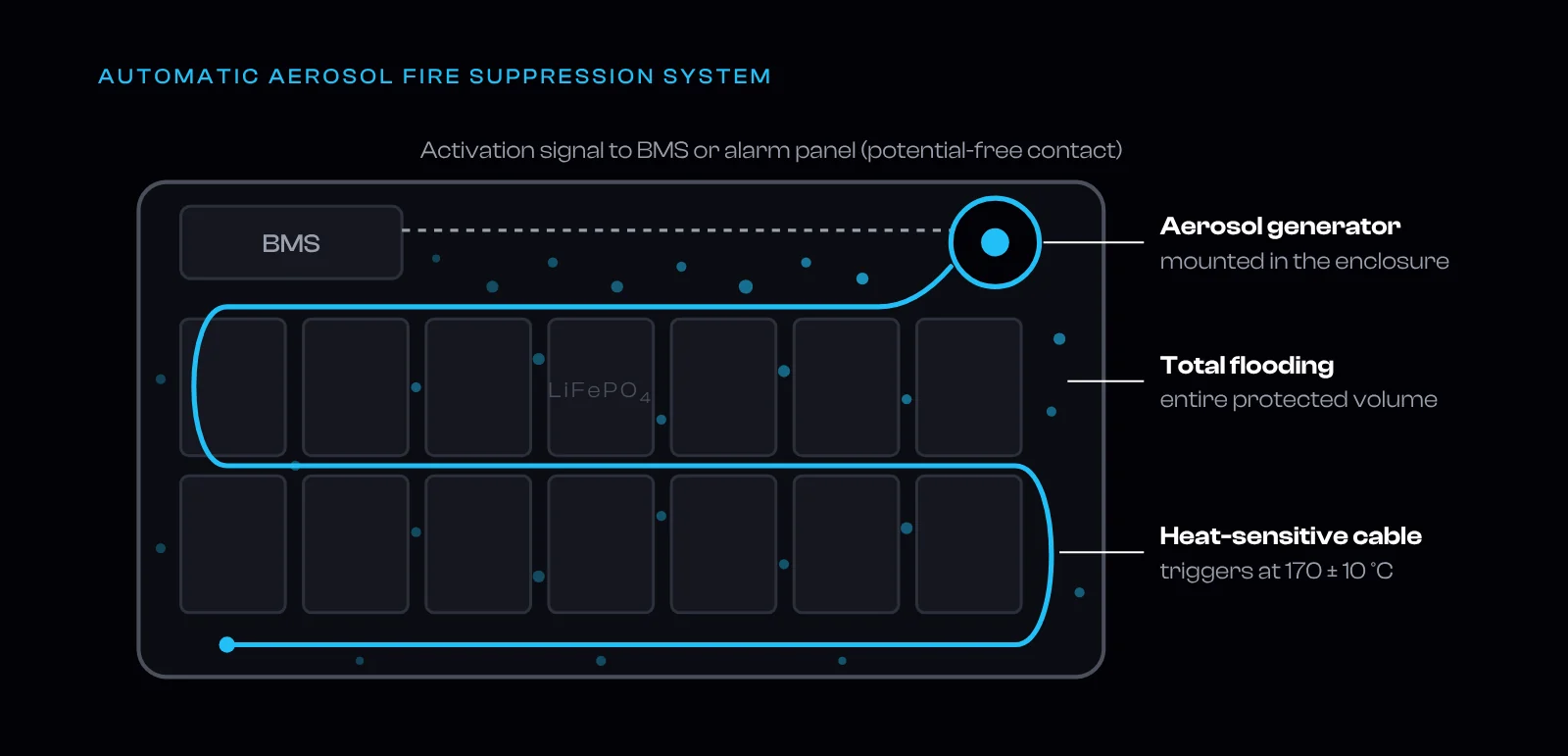
The system has three elements:
- An aerosol generator: a compact metal body holding the extinguishing agent in solid form, at atmospheric pressure. It is bolted inside the battery enclosure.
- A heat-sensitive cable that runs from the generator through the critical areas of the pack, between the cells.
- Signal wiring: an input to trigger it electrically and an output that confirms it has activated.
How it works, step by step
1. Detection. If any point of the heat-sensitive cable reaches 170 ± 10 °C, the system triggers on its own. It needs no power or electronics: it works even with the machine switched off or the battery disconnected. It can also be triggered by an electrical signal (12 V DC, 0.7 A or more) from the BMS or an alarm panel.
2. Discharge. The generator activates in under 5 seconds. A controlled reaction turns the solid agent into an aerosol of sub-micron particles that fills the entire enclosure within seconds. It is a total flooding system: there is no need to aim at the fire, because the aerosol reaches every gap.
3. Suppression. The aerosol works in two ways at once, explained in the next section.
4. Alert. A normally open potential-free contact closes when the system activates. It can be wired to the BMS, the machine's PLC or the facility's alarm panel, so someone knows an event has occurred and where.
Why it puts out the flame
A fire needs heat, fuel, oxygen and a self-sustaining chemical chain reaction. The aerosol attacks two of those four elements:
- Physical action: it absorbs heat. The metal salts and carbonates in the aerosol decompose by absorbing heat (an endothermic reaction). The temperature at the fire source drops and combustion loses energy.
- Chemical action: it breaks the chain reaction. A flame is sustained by highly reactive free radicals (H•, OH•, O•). The potassium and strontium ions in the aerosol capture them and turn them into stable molecules. Without those radicals, the flame goes out.
Particle size is the key. With particles smaller than one micron, the contact surface with the flame is huge for a very small mass of agent, and they stay suspended in the enclosure air for minutes instead of settling like a conventional powder.
Why aerosol and not another system
Inside a battery enclosure there is little space, vibration, temperature swings and no access for maintenance. That rules out almost everything used in buildings:
- It is not pressurised. No cylinders or pressure vessels that can lose charge or need inspection.
- It needs no pipes or nozzles. The generator discharges directly into the volume it protects.
- It needs no maintenance for 10 years. You only need to check that the wiring is in good condition.
- It is compact: the standard format measures Ø 72 × 27 mm and weighs about 230 g.
- It works from −50 to +95 °C, the same range a battery may face in a cold store or a warehouse in summer.
- The agent contains no halons and does not deplete the ozone layer, and the manufacturer declares it non-toxic and non-corrosive.
Technical data
We use two formats depending on the free volume of the enclosure:
| Compact format | Standard format | |
|---|---|---|
| Protected volume | up to 0.2 m³ | up to 0.6 m³ |
| Thermal activation | Heat-sensitive cable, 170 ± 10 °C | Heat-sensitive cable |
| Electrical activation | 12 V DC, ≥ 0.7 A | ≥ 700 mA |
| Discharge time | < 5 s | ≤ 12 s |
| Operating temperature | −50 to +95 °C | −50 to +100 °C |
| Feedback signal | Potential-free contact (NO) | Potential-free contact |
| Dimensions and weight | 80 × 70 mm (body) | Ø 72 × 27 mm, 230 g |
| Service life | 10 years | 10 years |
Data supplied by the device manufacturer, in accordance with XF 499.1-2010, the standard for thermal aerosol fire extinguishing devices.
What it does and what it doesn't
Precision matters here, because this is where many marketing messages exaggerate. An aerosol system extinguishes the flame and lowers the oxygen level inside a closed volume such as the battery enclosure. In DNV GL tests with condensed aerosol on lithium cells, the flame was consistently put out in about 10 seconds and oxygen stayed below 15% for 10 minutes (DNV GL report for Stat-X, 2017).
What an aerosol does not do is cool the inside of a cell that is already in thermal runaway. In those same tests, the cells' interior stayed above 300 °C for more than half an hour. More recent confined-space studies also show that aerosol greatly reduces the flame but performs less well than other agents as a coolant (Jia et al., Batteries, 2026).
That is why we do not present it as a magic solution, but as what it is: a second layer that puts the fire out where it starts, stops the flame from leaving the enclosure and reaching the machine or its surroundings, raises the alarm and buys time. Making sure a cell never reaches that point is the job of the first layer.
If the system activates
- Do not touch the generator until it has cooled: its casing can reach 200 °C.
- Ventilate the area before opening the enclosure.
- Take the battery out of service and contact NCPower for an inspection.
The two layers in an NCPower battery
A battery's safety does not depend on a single device, but on layers that act at different moments. The first works all the time to keep the problem from starting. The second only acts if, despite everything, fire appears.
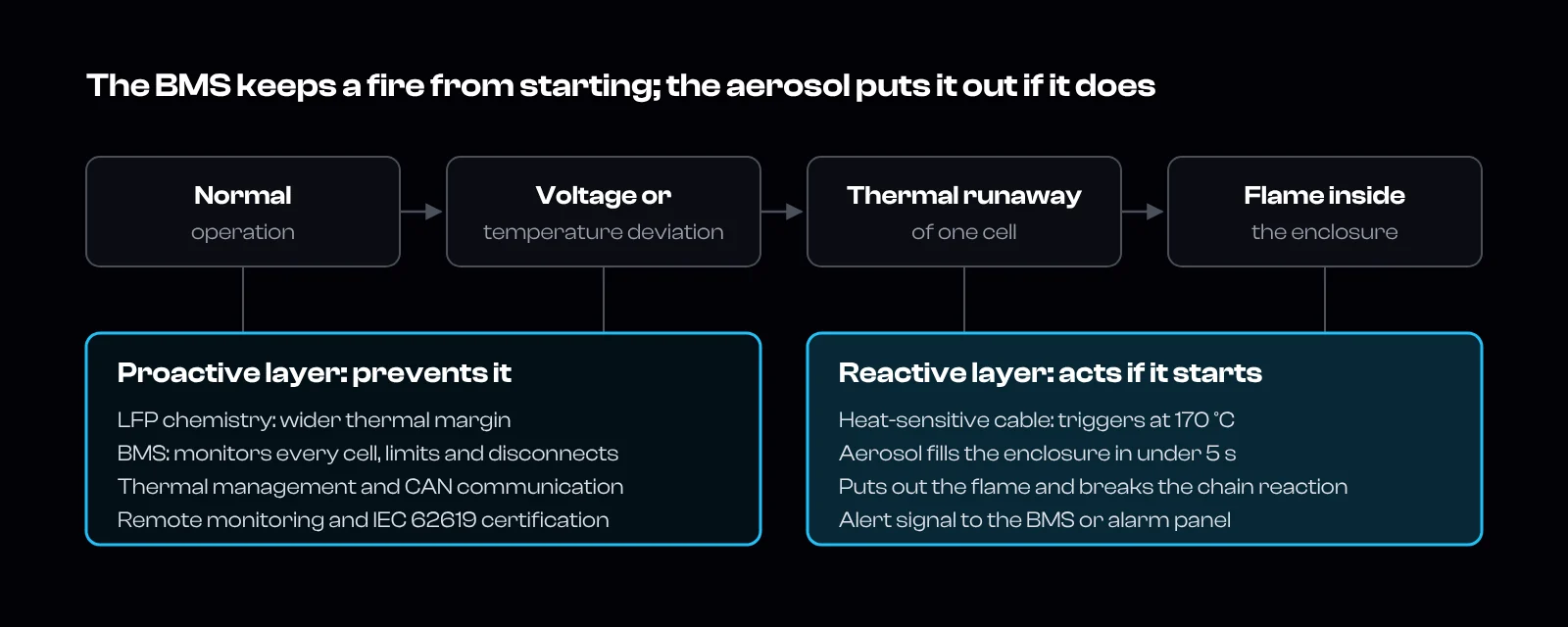
Each stage has its own response. While the battery runs normally, or when something starts to drift, the proactive layer acts. If a cell goes into thermal runaway and a flame appears, the reactive layer takes over.
Proactive layer. All our batteries use LFP cells and a BMS that monitors every cell's voltage, the current and the temperature, and limits or disconnects the battery before it leaves its safe zone. They communicate over CAN bus with the machine, the AGV or the charger. For cold climates we offer the Intelligent Thermal Management System, with heating pads that prevent cells from charging below their minimum temperature. And with remote monitoring through NCPower Cloud Data Center we follow each battery over time and can act before a deviation becomes a failure.
Reactive layer. Every NCPower battery comes as standard with the automatic aerosol fire suppression system inside the enclosure, with autonomous thermal triggering and an alert signal.
Third-party backing. NCPower holds UN 38.3 (transport), IEC 62619 (safety of industrial lithium batteries), R100.04 (safety of the energy storage system in electric vehicles) and R10 (electromagnetic compatibility) certifications, and we manufacture under an ISO 9001 certified quality system.
Download the datasheet
We have summarised the fire suppression system in a two-page datasheet, with the operating diagram, the suppression principle and the technical data for both formats.
Download the datasheet: Automatic aerosol fire suppression system (PDF, 2 pages)
Frequently asked questions
Is a lithium battery more dangerous than a lead-acid one?
Not in general: they carry different risks. Lead-acid gives off hydrogen while charging and requires a ventilated charging room. An LFP battery releases no gas in normal use; its risk is thermal runaway, which is prevented by the BMS and contained by the fire suppression system.
Why does NCPower use LFP rather than NMC?
Because an LFP cell starts to run away at higher temperatures, releases less energy if it does, and does not add oxygen to the fire. For industrial equipment, stability matters more than energy density.
Does the fire suppression system need maintenance?
No. It has a 10-year service life with no refilling or pressure checks. You only need to check the wiring during battery inspections.
Does it work when the machine is switched off?
Yes. Triggering through the heat-sensitive cable needs no power. It protects the battery at night, when parked or during transport.
Can it go off by mistake?
Thermal triggering requires 170 °C at the cable, a temperature a battery in normal operation does not reach. Electrical triggering only happens if the BMS or the alarm panel commands it.
What happens to the battery after an activation?
It is taken out of service. Ventilate, let it cool down and contact NCPower to have it inspected.
Can I add it to an older NCPower battery?
Ask our technical team: it depends on the model and the free space in the enclosure.
Shall we talk about your battery?
If you are considering moving your fleet to lithium or designing an electric machine, request a preliminary consultation and we will explain how both safety layers fit your case. You can also write to us from the NCPower contact page.
Sources
- The Driven (2023): Petrol and diesel cars 20 times more likely to catch fire than EVs, with MSB data
- Keyser, Darcy et al. (NREL/NASA, 2015): Internal Short-Circuit Instigator in Lithium Ion Cells
- Utility Dive (2026): Battery system failures fell 98% in 7 years, with EPRI data
- Utility Dive (2024): Cells and modules not responsible for most BESS failures (EPRI, PNNL, TWAICE)
- Battery Design: NMC vs LFP Safety, what the data actually shows
- Electric and Hybrid Vehicle Technology (2025): LFP vs NMC thermal runaway
- DNV GL (2017): Lithium battery testing report for Stat-X condensed aerosol
- Jia et al. (2026): Experimental study on fire suppression of lithium-ion battery module with different extinguishing agents in confined space, Batteries 12(7)