
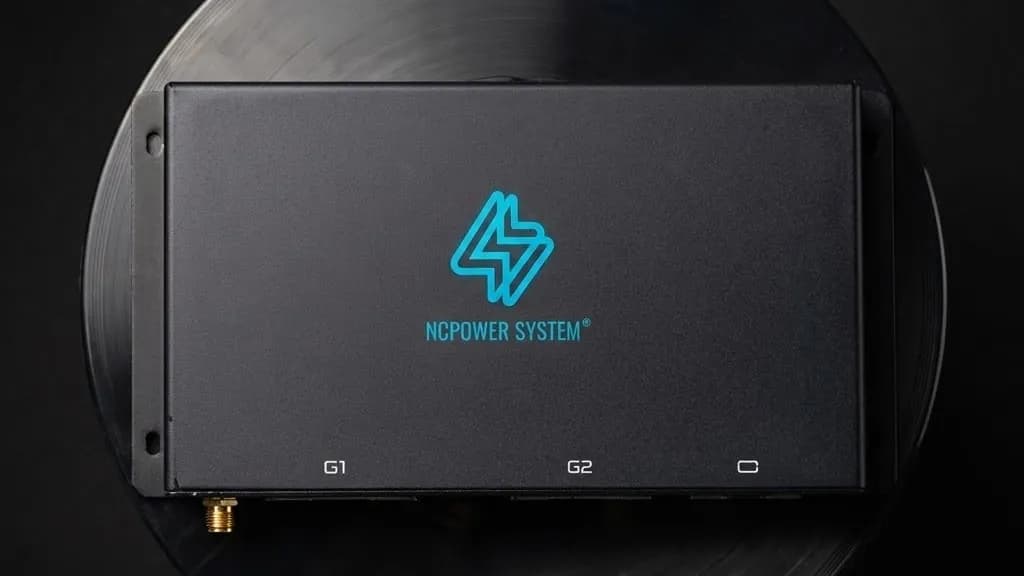
A BMS (battery management system) is the electronics that monitor, protect and balance every cell in a lithium battery. It's the difference between a battery that lasts for years and one that fails early. And although it rarely appears on a product sheet, it's one of the things you should look at most closely before you buy.
In this article, we explain what it does, why it's essential and what to ask about it, whether you're replacing the battery in an existing machine or designing a new vehicle.
What a BMS does, in one sentence
A BMS makes sure every cell in the battery stays within its safe limits, that none of them falls behind, and that the machine and the charger always know the battery's condition.
Why a lithium battery can't work without one
An industrial lithium battery isn't a single block: it's a set of many cells connected together. And those cells behave like a group of climbers roped together.
If one of them tires before the others, the whole group has to stop. It doesn't matter how fit the rest are. A battery works the same way: when the weakest cell reaches its limit, the entire battery has to stop delivering power to protect it.
Without anyone watching, the cells would drift apart over time: some more charged, others less. The battery would perform worse and worse and, in the worst case, a cell could end up working outside its safe limits. The BMS is the group's mountain guide: it watches each climber, sets the pace and makes sure nobody falls behind.
The four functions of a BMS
1. Monitoring
The BMS continuously measures the condition of each cell and the battery's temperature. Everything else depends on this: without measuring, you can't protect or balance.
2. Protection
If something goes outside normal limits, the BMS acts: it can raise an alarm, limit power or disconnect the battery before the problem gets worse. It protects against overcharging, over-discharging, excessive current and extreme temperatures, among other things. For example, it prevents charging below freezing, because doing so would permanently damage the cells.
3. Cell balancing
With use, it's normal for some cells to charge or discharge slightly more than others. The BMS evens them out so the whole group moves at the same pace. This function is called cell balancing, and it has the biggest influence on how long a battery lasts.
4. Communication
The BMS tells the machine and the charger how the battery is doing: how much charge is left, whether there are any alarms, and whether it can charge faster or slower. In industrial applications, this conversation usually happens over CAN bus, the most common "language" between batteries, machines and chargers.
Cell balancing: passive vs active
Not every BMS balances cells in the same way. There are two main approaches:
| Passive balancing | Active balancing | |
|---|---|---|
| How it works | Takes energy from the most charged cells and burns it off as heat | Moves energy from the most charged cells to the least charged ones |
| When it works | Usually only at the end of charging | Can also work while the battery is in use |
| It's like… | Holding back the climbers in front so the others can catch up | Helping the climbers at the back catch up with those in front |
| Main advantage | Simpler and cheaper | Corrects imbalances sooner and makes better use of energy |
Passive balancing is the most common approach on the market. Active balancing is more complex, but in batteries that work long hours every day, such as a multi-shift fleet or an AGV running non-stop, it helps the battery keep its performance for longer.
If you want to go deeper into how each type of balancing works, we explain it in detail in our article on cell balancing and battery life.
What to ask about the BMS before buying a battery
Whether you're replacing a battery or designing one for a new vehicle, these questions will help you compare suppliers:
- Who developed the BMS? A manufacturer that develops its own BMS can adapt it to your machine and support you directly. One that buys it from a third party depends on someone else for any change.
- How does it balance the cells? Only at the end of charging, or during use as well?
- How does it communicate with my machine and charger? Ask whether it's compatible with your equipment's CAN bus.
- What alarms does it have, and what does it do in each case? A good BMS warns you before it disconnects.
- Can I check the battery's condition remotely? Remote monitoring lets you spot problems before they stop the machine.
If you're choosing a battery from scratch, our guide to choosing an industrial lithium battery covers the other decisions: voltage, energy, size and weight.
NCPower's BMS
At NCPower, we develop our own BMS instead of buying it from a third party. It balances the cells continuously, during both charging and discharging, communicates with the machine and the charger over CAN bus, and uses several levels of safety alarms. It can also connect to our remote monitoring platform, so you can check the condition of every battery from anywhere.
Learn more about our BMS with CAN bus communication on our technology page.
Where do we start?
Replacing a lead-acid battery? Send us a photo of your current battery's rating plate, and we'll tell you which lithium battery matches it.
Designing a new vehicle? Tell us what your vehicle needs, and our engineers will explain how to integrate the battery and its BMS with your system.
Write to us through the NCPower contact page and we will get back to you.