
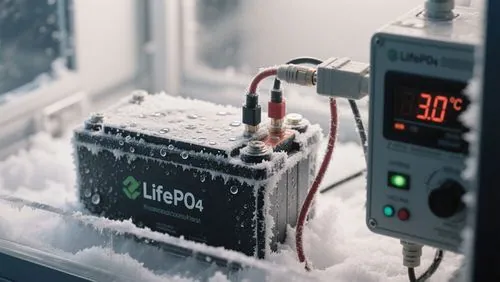
A lithium battery can keep working in cold weather, but it must not be charged below 0 °C unless it has a system that warms its cells. That's the core of lithium battery cold weather charging. In the cold it delivers a little less energy and accepts charge more slowly, and if it's charged while frozen it's damaged permanently. That's the difference between a truck that lasts years in a freezer store and one that loses capacity in its first winter.
This article covers what cold does to lithium, why charging is the delicate moment, how self-heating batteries solve it and what to ask before you buy, whether you're replacing the batteries in your cold-store fleet or designing a machine that works outdoors.
The golden rule: work cold, charge warm
A lithium battery can work in the cold, but it should only charge warm. Discharging at low temperatures costs it some performance for a while; charging below freezing costs it capacity for good.
Jogging in the cold vs sprinting in the cold
Let's think of an athlete in the middle of winter. They can go for a run in the cold if they've warmed up first: they perform a bit less, but they don't get hurt. What they must not do is sprint without warming up. That's when something tears.
Lithium cells work the same way. Working (discharging) in the cold is an easy jog: the battery performs a little less, but it isn't harmed. Charging is the sprint: pushing energy in fast puts real strain on the cell, and if the cell is cold, it gets injured.
What is lithium plating?
That injury has a name: lithium plating. When you charge a cell below 0 °C, the lithium can't enter the electrode properly and settles as a layer of metal on its surface. That layer doesn't go away: it takes capacity permanently and, in severe cases, can damage the cell from the inside.
What changes in a lithium battery in cold weather
1. Capacity
In the cold, the chemical reactions inside the cell slow down and the battery delivers a little less energy at that moment. The loss is temporary: when the cell warms up again, it gets its capacity back.
Lead-acid suffers much more. According to Toyota Material Handling, a lead-acid battery that performs best at 30 °C drops to 55% of its available capacity at -20 °C.
2. Charging
This is the critical point. Without heating, a lithium battery must not be charged below freezing, and close to that temperature it's better to charge it more slowly. That's why your BMS has to know the temperature of the cells at all times, not just the casing.
3. Heating
Batteries built for the cold have heating elements in their modules. When the temperature drops below a threshold, the BMS switches them on and warms the cells before allowing a charge. It's the athlete's warm-up before the sprint.
4. Condensation
In a cold store, the enemy isn't only the cold. When a truck leaves -18 °C for a warmer dock, humid air condenses on the battery, like on a cold glass in summer. A well-sealed battery with a suitable IP rating keeps that moisture away from the electronics.
Standard vs self-heating lithium battery
| Standard lithium | Self-heating lithium | |
|---|---|---|
| How it works | The BMS watches temperature and blocks charging when it's too cold | The BMS switches on module heaters and warms the cells before charging |
| When it acts | It only protects: it stops charging below freezing | It heats whenever temperature drops below a threshold, including during the shift |
| It's like… | An athlete who knows not to sprint cold | An athlete who always warms up before the sprint |
| Main advantage | Simpler and more affordable | Can charge and perform in freezers or outdoors in winter |
When each one makes sense. A standard battery works well in chilled stores, between 2 and 8 °C, and outdoors in mild climates, as long as it charges somewhere above freezing. Built-in heating pays off in freezer stores, at -18 °C or below, and for airport ground equipment that spends winter nights outdoors and has to charge right there.
How to look after lithium in cold stores and outdoors
- Charge in a warm area if you can. If the truck leaves the cold store to charge, the charger should be somewhere above freezing, ideally with a few degrees of margin.
- Use breaks wisely. Opportunity charging works in the cold too, but only if the battery can warm its cells or charges outside the cold store.
- Don't leave it parked and empty in the cold. A cold, flat battery takes longer to warm up and accept charge again.
- Watch for condensation. Sudden moves between cold store and dock are what create the most moisture.
What to ask about cold before you buy
- What temperature range can the battery charge and discharge in? Ask for the two ranges separately: the charging range is always narrower.
- Does it have built-in heating, and when does it switch on? It decides whether you can charge inside the cold store or outdoors.
- Where does the BMS measure temperature? It has to measure it at the cells, where the damage happens.
- What IP rating does it have? That's what protects it from condensation as it moves in and out of the cold store.
- What's its usable energy at your cold-store temperature? What matters is what you get at -18 °C, not at 25 °C.
- What happens to the warranty if it works in the cold? Ask whether there are special conditions for freezer stores.
The cold at NCPower
Our BMS, which we develop ourselves, continuously measures the battery's temperature and protects against extreme temperatures: among other things, it stops the battery from charging below freezing, which is exactly what prevents lithium plating. We explain it in detail in our article on what is a BMS.
To stay with the analogy, the BMS is the coach who won't let you sprint cold. If your operation runs in freezers or outdoors, ask us for a preliminary consultation and we'll work out with you how to protect the cells in your lithium forklift battery or your GSE lithium battery.
Where do we start?
Lithium battery cold weather charging works when the battery, the charger and the cold store are planned together.
Running lead-acid forklifts in cold stores? Send us a photo of your current battery's nameplate and tell us your cold-store temperature. We'll tell you which lithium battery matches it and where it's best to charge it.
Designing a machine for cold or outdoor work? Tell us the temperatures it works in and where it charges, and our engineers will explain how to protect the cells.
You can contact us here.