

The battery and charging infrastructure market is experiencing rapid growth due to the demand for electric vehicles. Still, there are certain challenges and nuances to consider. In this article we will talk about the lithium battery industry and future forecasts, collecting data from the latest reports.
Keys to the lithium battery and electric vehicle market
Demand for EV batteries is expected to continue to rise, with shipments in 2021 94% higher than in 2020. Demand for EV batteries is projected to reach 3,486 GWh in 2030, and manufacturers are expected to increase their capacity to meet this demand.
However, the pricing of battery packs is still a challenge. Prices were expected to fall below $100/kWh by 2024, but rising materials prices have affected costs.
The adoption of new battery pack technologies and designs, as well as the use of new chemical mixtures, will help reduce costs in the future.
In terms of battery materials, it is expected that the supply of lithium, cobalt, manganese and nickel may be limited in the next decade. Investment in new refining and raw material extraction facilities will be necessary to meet growing demand.
A significant increase in demand for lithium and nickel is expected, and collaborative approaches between governments, manufacturers, miners and recyclers will be needed to ensure adequate supply.
The expected scenario for 2050 requires huge increases in the supply of raw materials for batteries going forward.
Without large-scale battery recycling, the cumulative demand for lithium, nickel and cobalt exceeds currently known reserves during this period.
However, with battery recycling, the door opens to building a circular economy by the middle of this century.
What about the necessary charging infrastructure?
Regarding charging infrastructure, it is estimated that a cumulative investment of more than $1 trillion will be needed in EV charging infrastructure over the next 20 years. Rapid expansion of the public charging network will be required to meet the growing fleet of electric vehicles.
In the mass market for electric vehicles, many drivers are less likely to have the ability to charge their vehicles at home. Instead, they rely more on public charging infrastructure.
As charging infrastructure usage and average power delivery capacity increases, the number of electric vehicles per public charging connector also increases. Currently, there are between 5 and 20 electric vehicles per public charging connector in most markets, but this number is expected to increase to between 30 and 45 in the future.
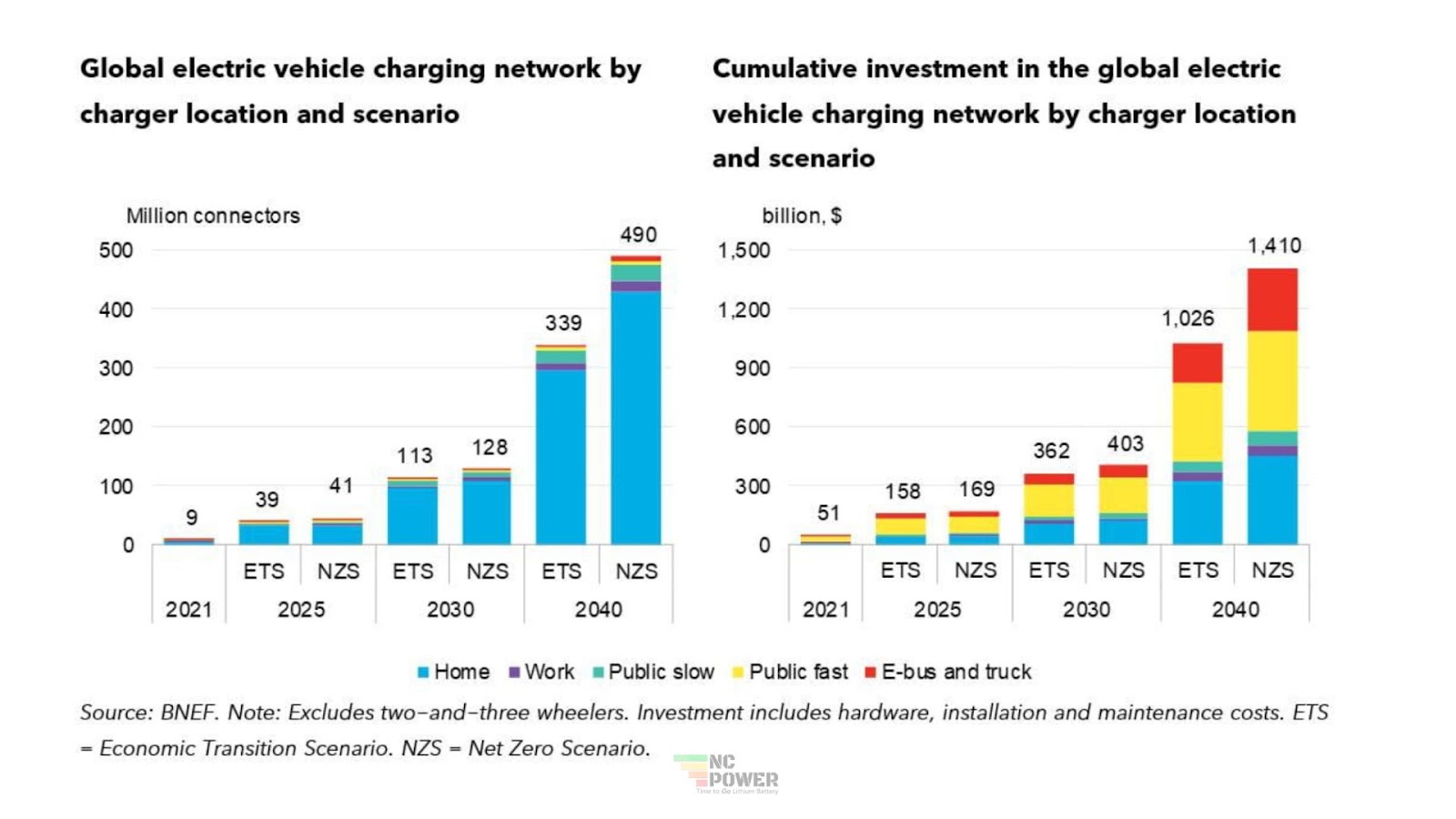
The installation of fast chargers will be crucial, and is expected to represent 60% of the investment in charging infrastructure.
An increase in vehicles with two-way charging (V2G) capability is also expected, which will allow for greater integration of renewable energy and cost reduction in the electrical system.
Conclusions
In summary, the battery market and charging infrastructure are experiencing significant growth due to the increasing demand for electric vehicles.
Having said that, the challenges related to material prices and the need to rapidly expand the charging network require collaboration between various actors to ensure adequate supply and robust charging infrastructure.