
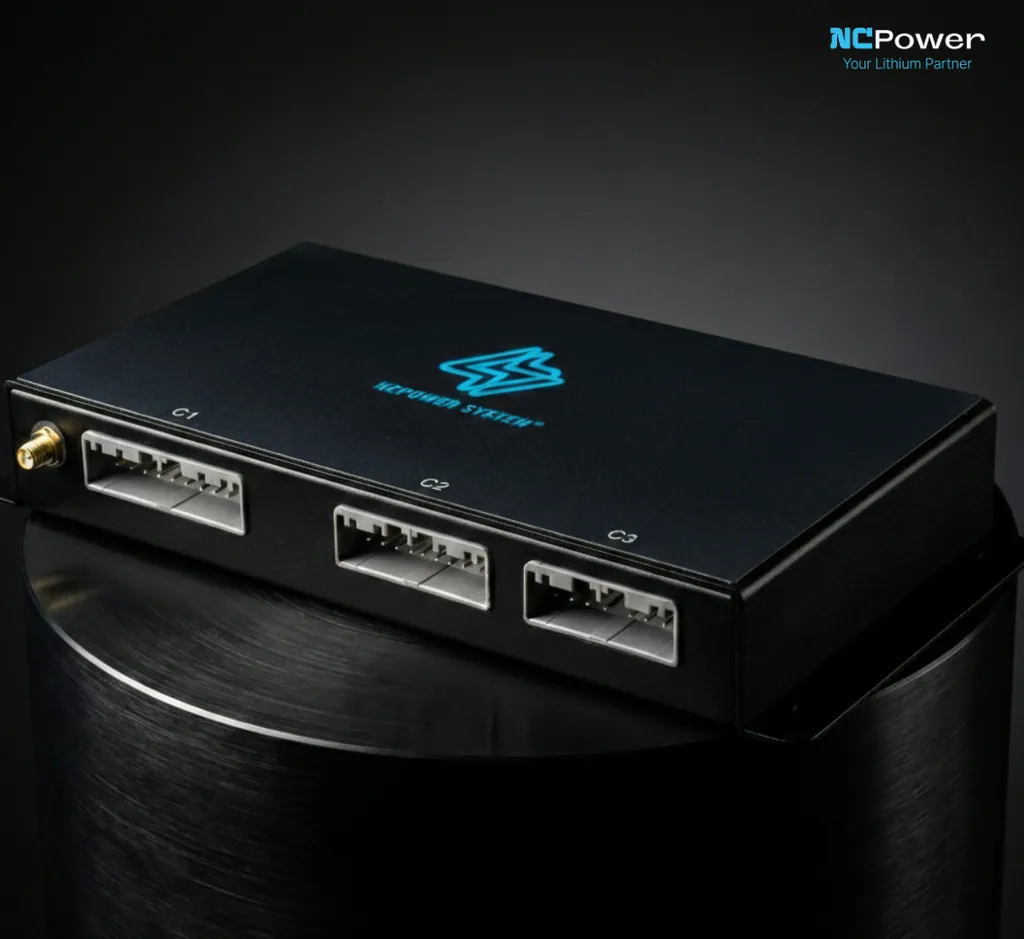
If the cells are the muscles of a lithium battery, the BMS (Battery Management System) is its brain. Its main function is to ensure that none of the cells suffer, ensuring that they all work in harmony. But how do you achieve it? The key is in a fundamental technical process: balancing cells and batteries.
In this article we explain what types exist and how the NCPower system has broken the limitations of traditional methods in its search for constant innovation.
If you want a more technical view of architecture and control, you can expand on our BMS technology page. And if your application is sectoral, you can also land the focus on light vehicle or mobile robotics.
The problem: Cell imbalance
Imagine a battery as a team of runners. If one gets tired sooner (has less voltage), the entire team must stop, even if the other athletes are not tired. Without a BMS that matches runners, you would be wasting the energy of athletes who still have strength, drastically reducing the autonomy of your machine.
1. Passive Balancing: The Basic Standard
Passive rolling is the most common method. Its operation is simple: when one cell reaches its maximum voltage before the others, the BMS uses a resistor to dissipate that excess energy in the form of heat, also heating the main board and the rest of the electronic components.
- Advantage: It is an economical and simple technology to implement.
- Disadvantage: It is inefficient and slow. By generating heat within the electronics itself, the system is usually limited to balancing only at the end of the load and with very low currents so as not to burn the components.
2. Active Balancing: The ideal solution?
Active balancing attempts to be more "ecological": instead of throwing away excess energy, it transfers it from cells with more charge to those with less.
- Advantage: Theoretically it does not waste energy.
- Disadvantage: In the industrial sector, its effectiveness is questionable. The transfer channels are usually very narrow (just a few milliamps), making it too slow for high-capacity batteries. In addition, it adds electronic complexity that increases the risk of breakdowns.
3. The NCPower Approach: Dynamic, Powerful, Decoupled Balancing
After years of experience in professional electric mobility, at NCPower we decided that we could not settle for the standard. We have developed a system that combines the reliability of the dissipative method with unprecedented power and thermal management.

Heat, out of electronicsThe big flaw with passive BMS is that the resistors heat up the main board. We have thermally isolated the BMS, removing the balancers to an external module protected by an aluminum casing. This allows us to handle much higher balancing currents without risking the life of the electronics.
Balancing in loading... and in unloading
Here lies our greatest innovation. While the competition waits until the battery is almost full to start working (prolonging charging times), our BMS is dynamic:
- Balances during charging: From the first moment, optimizing the time the machine spends in the socket.
- Balance during discharge: While the machine is working, our system is already compensating for differences between cells.
Result: Maximum Uptime
By balancing at all times, we prevent the battery from reaching the end of the day with critical imbalances. This eliminates unexpected shutdowns and ensures that 100% of the battery capacity is usable for much longer.
Conclusion
Choosing a BMS is no small decision. While conventional passive or active systems are typically reactive and slow, the NCPower system is proactive. By taking the heat out and constantly balancing, we ensure that your investment performs at its best from the first minute to the last cycle of the battery's life.
Recommended next step
If you are evaluating a lithium battery for your operation and want to validate technical feasibility (discharge peaks, charging window, CAN integration and security), you can contact our team for an initial review.