
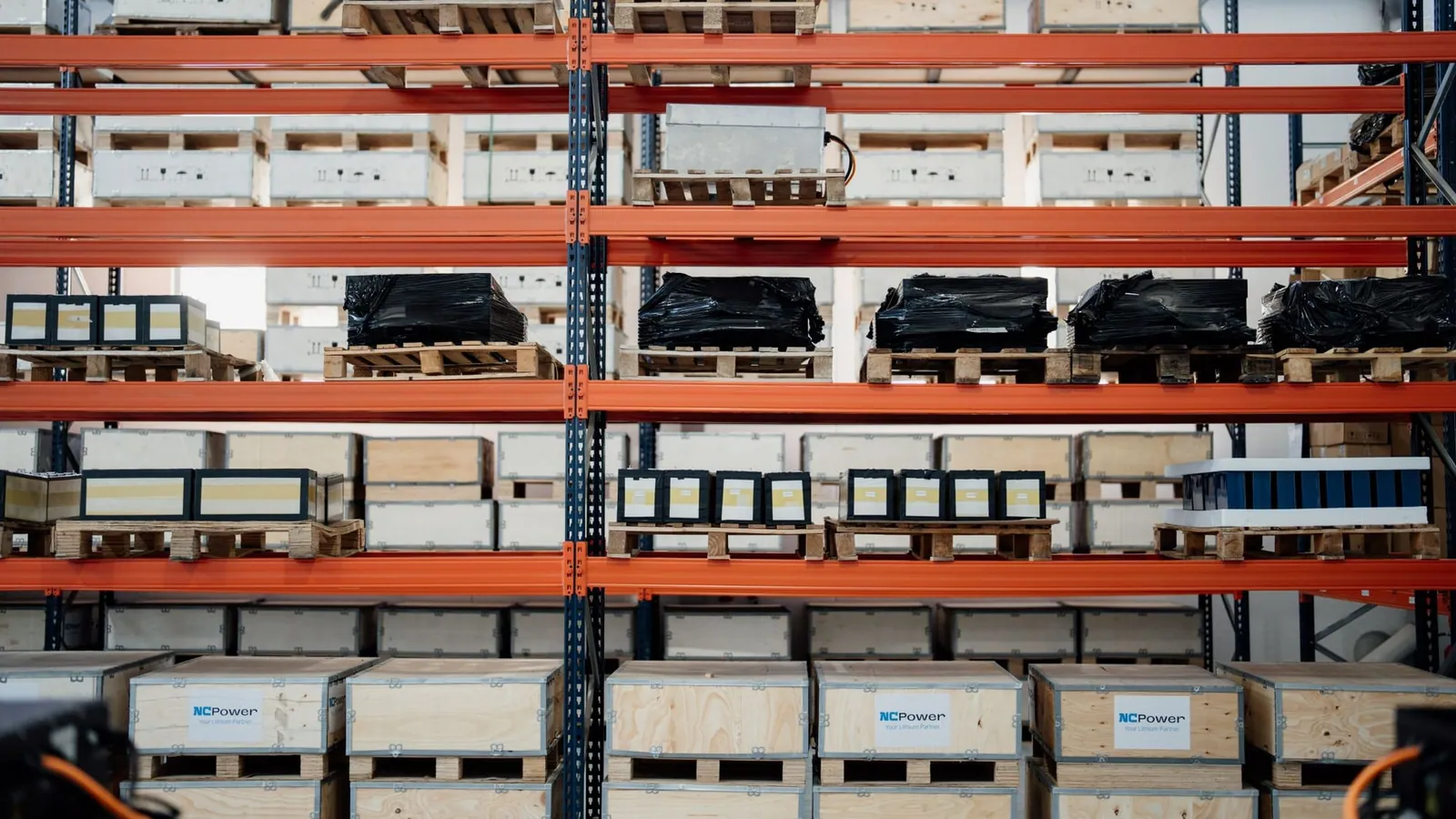
Choosing an industrial lithium battery comes down to four decisions: voltage, energy, size and weight, and communication with the machine. It doesn't matter whether it's for a forklift, an AGV or a light electric vehicle. What changes is where you start.
So first, one question: are you replacing the battery in a machine you already own, or designing the battery for a new vehicle?
| If you're replacing | If you're designing | |
|---|---|---|
| Your situation | You have a machine with a lead-acid battery and want to switch to lithium | You're developing a new vehicle or machine |
| Your starting point | The rating plate on your current battery | What your vehicle needs to do |
| It's like… | Buying replacement tyres: you check what's written on the ones you have | Designing the tyres for a new car: you start from its weight and speed |
The four decisions in the first section apply to both. If you're still deciding whether lithium is worth it, start with our lead-acid vs lithium forklift battery comparison.
The four decisions behind every industrial battery
Voltage: set by the machine's electrical system
You don't choose the voltage: the motor, controller and charger decide it. A battery with a different voltage simply won't work.
What can be confusing is that lithium and lead-acid voltages don't match exactly. A 48 V lead-acid battery is made of 24 cells at 2 V each. A LiFePO4 lithium battery uses 3.2 V cells, so 16 cells give you 51.2 V. They're two different routes to the same height, which is why a 51.2 V lithium battery replaces a 48 V lead-acid one.
Energy: from amp-hours to kilowatt-hours
Amp-hours (Ah) tell you how much charge a battery holds, but to compare batteries with different voltages, energy in kilowatt-hours (kWh) is more useful. The maths is simple:
Energy (kWh) = voltage (V) × capacity (Ah) ÷ 1,000
Two real NCPower examples:
| Model | Voltage | Capacity | Energy |
|---|---|---|---|
| MH51460 (forklifts) | 51.2 V | 460 Ah | 23.5 kWh |
| NC5108A (custom pack) | 51.2 V | 150 Ah | 7.7 kWh |
Same voltage, but one stores three times more energy than the other. Think of two fuel tanks for the same engine, just different sizes.
Size and weight: it has to fit and balance
The battery has to fit in the space the machine allows for it, and its weight matters more than you might think. Lithium weighs around 55% less than lead-acid. In many machines that's a plus: less weight, more range. But in others, such as counterbalance forklifts, the battery is part of what keeps the machine stable, and a lighter battery becomes a problem. We come back to this in Path 1.
Communication and BMS: how the battery talks to the machine
A lithium battery includes a BMS (Battery Management System): the electronics that monitor every cell, protect the battery and tell the machine and charger what state it's in. For this to work, the battery and the machine need to speak the same language. In industrial applications, that language is usually CAN bus.
NCPower develops its BMS in-house and uses separate CAN channels for each role: one for diagnostics, one for the charger (so they can agree on the charging current) and one for the machine (its controller or display).
Path 1: replacing the lead-acid battery in a machine you already own
If you already have the machine, almost everything you need is written on the rating plate of your current battery: voltage, capacity, weight and sometimes dimensions.
- Voltage: find the lithium equivalent. The most common case is a 48 V lead-acid battery, replaced by a 51.2 V lithium one.
- Capacity: don't copy the lead-acid Ah figure one-to-one. Lithium makes better use of its stored energy and supports charging during breaks, so you don't always need the same size "tank".
- Weight: if your machine is a counterbalance forklift, the lithium battery must be ballasted, meaning extra weight is added to match the original lead-acid battery. Otherwise, the truck would lose lifting capacity. In lighter applications, such as pallet trucks or stackers, it can go without ballast.
- Charger: a lead-acid charger won't work with a lithium battery. The new battery needs a compatible charger that communicates with its BMS.
With this information, the next step is to find the right model. NCPower manufactures lithium forklift batteries from 24 V to 90 V, compatible with all major brands and currently available for customers.
Path 2: designing the battery for a new vehicle
If you're developing a vehicle, there's no rating plate to copy. You start from what the vehicle has to do:
- Duty cycle: how much energy it uses on average and how long it has to run between charges. For example, a vehicle drawing an average of 1 kW that needs to run for 6 hours between charges requires at least 6 kWh of usable energy, plus a safety margin.
- Peak power: when starting, climbing or lifting a load, the battery has to deliver high current for a few seconds. Both the cells and the BMS must be designed for those peaks.
- Space envelope: the maximum dimensions and weight the chassis can take. A custom battery is built around the vehicle, not the other way round.
- Integration: which communication protocol your controller uses, and what data you need from the battery (state of charge, state of health, alarms).
- Certification: plan for it from day one, not at the end. The most common are IEC 62619 (safety of industrial batteries), UN38.3 (required to ship lithium batteries) and the CE mark.
At NCPower, we go from concept to prototype and design custom lithium battery packs from around 5 kWh.
What changes by application
Forklifts, pallet trucks and stackers
The main challenge is compatibility with the existing machine and the counterweight. These machines usually run multiple shifts, so charging during breaks makes the real difference. Learn more about our material handling batteries.
AGVs and AMRs
They run autonomously, often around the clock, and charge at docking stations during idle time. Integration with the vehicle controller and the available space are usually the most critical factors. Learn more about our AGV and AMR lithium batteries.
Ground support equipment (GSE)
Baggage tractors, pushbacks and belt loaders work outdoors with highly irregular duty cycles. One key point: lithium batteries should only be charged above 0 °C, so in cold environments temperature management has to be planned in. Learn more about our GSE lithium batteries.
Light electric vehicles
Here, range, weight and road homologation come into play. Learn more about our light electric vehicle batteries.
Common mistakes when choosing a lithium battery
- Copying the Ah rating of the lead-acid battery without considering how lithium is used.
- Forgetting the counterweight in counterbalance forklifts.
- Choosing on price alone, without looking at how many shifts or hours the machine will work.
- Leaving certification until the end of a new vehicle project, when design changes are expensive.
- Keeping the lead-acid charger, which isn't compatible with a lithium battery.
Where do we start?
Replacing a lead-acid battery? Take a photo of your current battery's rating plate and send it to us. We'll tell you which lithium model matches it.
Designing a new vehicle? Tell us the voltage, the energy you need, the available space and the duty cycle, and our engineers will propose a solution.