
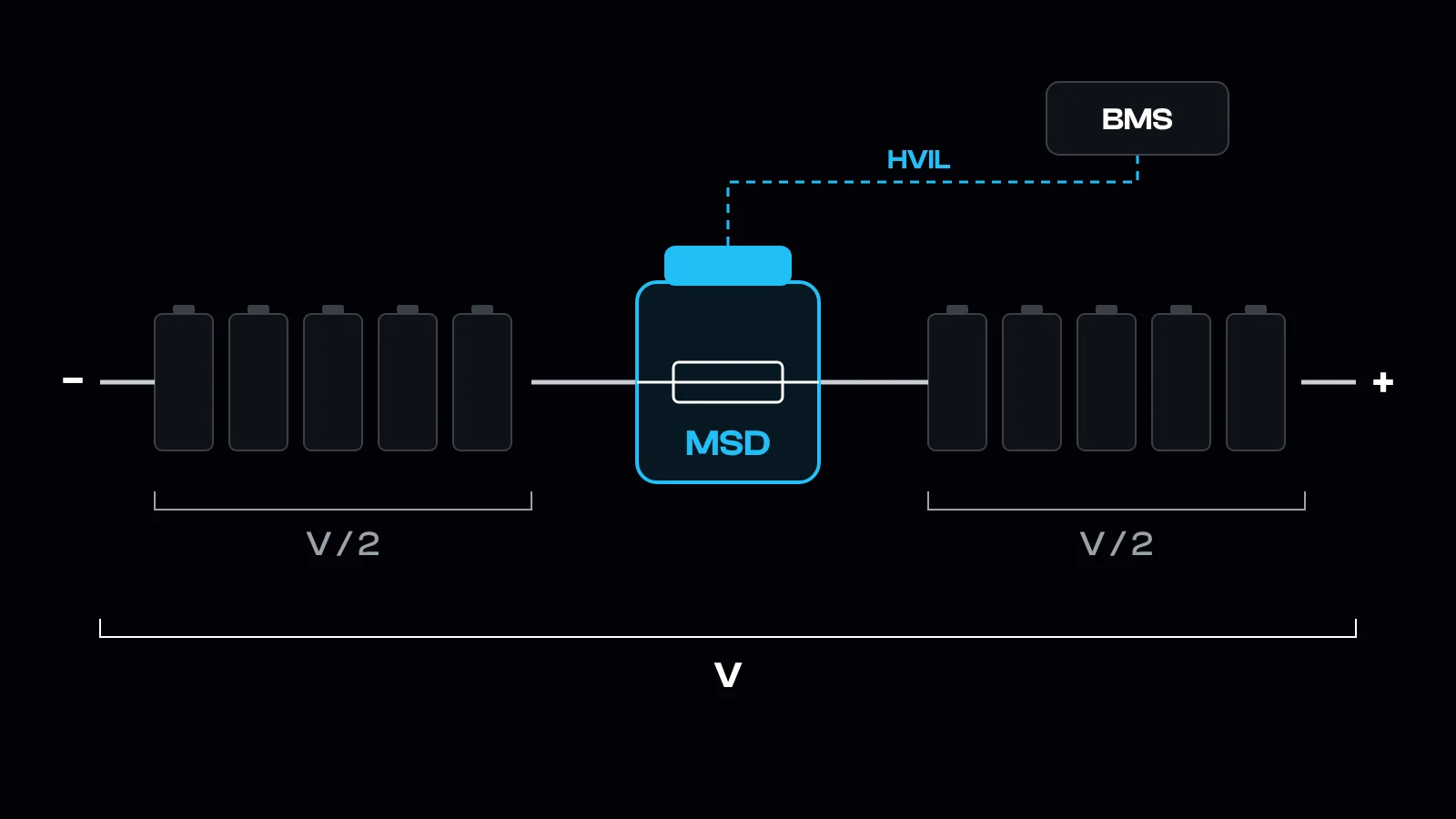
An MSD (Manual Service Disconnect) is a plug-in part that is removed by hand to open the circuit of a high-voltage battery before working on the vehicle. It usually contains a fuse and an interlock contact (HVIL) that signals the system before the power contacts separate. It is a small component, but whether a technician can open the vehicle safely depends on it.
In this article we explain what it is for, how it works inside, what to require of it when choosing one, and which batteries need it.
Why a high-voltage battery needs an MSD
A battery cannot be "switched off". Its cells always carry voltage, whether the vehicle is running or parked. What switches off are the contactors, the switches that connect the battery to the rest of the vehicle. The problem is that a contactor can fail closed (for example, if its contacts weld together after a short circuit), and then the technician would be facing hundreds of volts without knowing it.
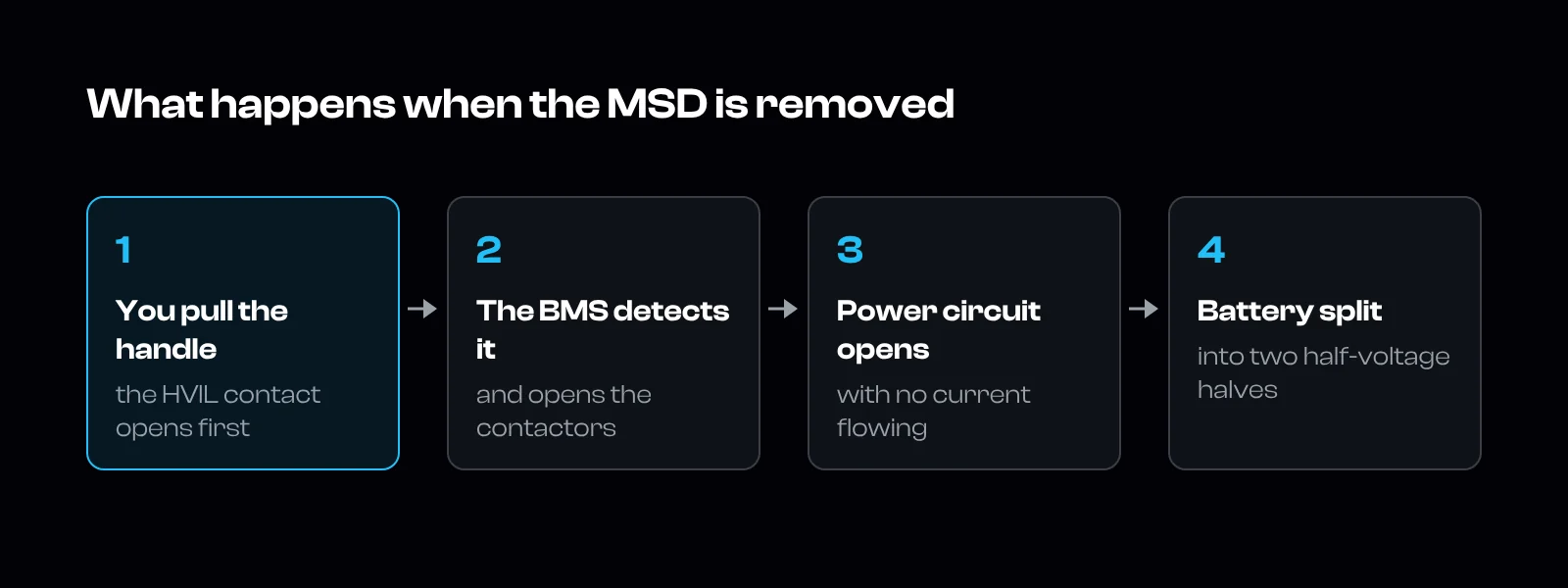
The MSD adds a physical, visible break that the technician controls: they remove it, keep it, and nobody can reconnect the battery while they work. In many designs it is also placed in the middle of the battery, between two groups of cells. When it is removed, the battery is split into two halves, each with half the voltage, and the full voltage between the terminals disappears.
For vehicles, the high-voltage threshold is set by UN Regulation No. 100: above 60 V DC, components fall into voltage class B and must be protected against direct contact. We explain it in our article on what ECE R100 type approval means.
The three functions of an MSD
1. Manual circuit break. This is its main function. The technician pulls the handle, usually in two steps (unlock and remove), and the high-voltage circuit is open.
2. Fuse. Most MSDs include a high-voltage fuse. If an external short circuit occurs, the fuse blows and opens the circuit. It has to be coordinated with the contactors and the cables: it must blow before the short circuit damages any of them.
3. HVIL interlock. HVIL (High Voltage Interlock Loop) is a signal circuit that runs through the high-voltage connectors. Inside the MSD, the HVIL contact is shorter than the power contacts, so it is the first to open when the handle is pulled. The BMS or the vehicle control unit detects the opening and commands the contactors to open. By the time the power contacts separate, no current is flowing through them, which avoids the electric arc that would form when opening a circuit under load.
What to require of an MSD
| Requirement | What to check |
|---|---|
| Voltage and current | Maximum battery voltage, the vehicle's continuous current and the peaks when starting or climbing a ramp, with margin |
| Fuse | Melting curve coordinated with contactors and cables; versions with or without fuse depending on the architecture |
| Touch protection | With the MSD removed, no live part must be reachable with a finger (IPXXB) |
| Sealing | Mounted in the battery lid, IP67 as a minimum; IP6K9K if the vehicle is pressure-washed |
| Fire behaviour | Plastics rated UL 94 V-0, so the MSD is not the weak point of the enclosure |
| Vibration and retention | Vibration tests on the component itself; a contact that loosens causes intermittent cut-outs |
| Ageing | It must stay sealed after long-duration temperature tests |
| Mating cycles | Few over its life, but every one has to work; ask the manufacturer for the figure |
Vibration deserves attention. An MSD that loses contact pressure over the years rarely fails all at once: it causes occasional high-voltage cut-outs while driving that come and go. These are among the hardest faults to diagnose, because when the vehicle reaches the workshop everything works.
Common design mistakes
- Placing it out of reach. If removing the MSD means dismantling half the machine, the safety procedure ends up being skipped.
- Placing it in an exposed area subject to water, mud or impacts without allowing for it in sealing and mechanical protection.
- Not integrating the HVIL into the vehicle logic. If nobody reads the signal, the MSD opens with current flowing.
- Choosing the fuse from a catalogue without coordinating it with the rest of the power circuit.
- Not documenting the service procedure for the workshop.
The service procedure, step by step
Each manufacturer defines its own, but the usual sequence is:
1. Switch off the vehicle and remove the key.
2. Remove the MSD and keep it, so nobody can put it back.
3. Wait the time specified by the manufacturer for the inverter capacitors to discharge.
4. Verify the absence of voltage with measuring equipment rated for that voltage.
5. Work with the personal protective equipment required for high voltage.
What about low-voltage batteries?
In the 24 to 48 V batteries of forklifts, pallet trucks or AGVs, an MSD is not usually fitted. Disconnection is done with the battery connector and the machine's own emergency stop. The MSD comes in when the voltage rises to hundreds of volts: road electric vehicles, high-voltage industrial and autonomous vehicles, or electrified construction machinery.
Where do we start?
If you are designing a vehicle with a high-voltage battery, the service disconnect is best defined with the battery manufacturer from the start: where the MSD goes, which fuse it carries and how the HVIL is integrated with the BMS and the vehicle control unit. Changing it once the enclosure has been designed is far more expensive.
Designing an electric vehicle? Tell us the voltage, the power and how the vehicle will be maintained, and our engineers will explain how to integrate the battery, its BMS and its safety elements. You can also ask us for a preliminary consultation.
Write to us from the NCPower contact page and we will get back to you.