
LiFePO4 vs NMC is the choice between the two most widely used cell chemistries in lithium batteries today: LiFePO4 (lithium iron phosphate, also called LFP) and NMC (nickel manganese cobalt). The difference comes down to this: NMC stores more energy per kilo, while LiFePO4 lasts more cycles with a wider safety margin. Picking one or the other decides how much your battery weighs, how many years it lasts and what each cycle costs you. Chemistry rarely makes the first line of a quote, but it's one of the first things you should ask about.
This article covers how they differ, when each one makes sense and what to ask before you buy, whether you're replacing a forklift battery or designing an AGV or a new vehicle.
LiFePO4 vs NMC in one sentence
If your machine works long hours, charges often and works around people, go LiFePO4. If every gram and every centimetre outweighs everything else, go NMC.
Why there's no single "best" chemistry
Choosing a battery chemistry is a lot like choosing a backpack for an expedition.
NMC is the lightweight alpine pack. It carries a lot in very little weight and space, but it needs more care and costs more. LiFePO4 is the heavy-duty work pack. It weighs more for what it carries, but it takes years of daily use, handles heat and knocks better, and costs less.
Neither is better in the abstract. The right one is the one that fits the route: how much weight you can carry, how many hours a day you walk, and how many years it has to last.
How LiFePO4 and NMC differ
1. Energy
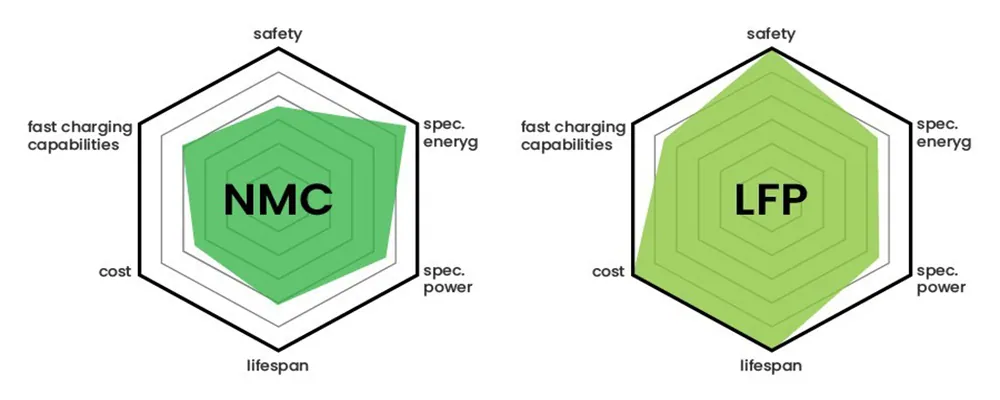
This is NMC's big advantage. An NMC cell typically stores 150 to 220 Wh per kilo, and the most advanced ones pass 300. A LiFePO4 cell usually sits between 90 and 170 Wh/kg, although the newest ones are getting close to 200.
Voltage differs too: 3.2 V per cell for LiFePO4 against 3.6–3.7 V for NMC. To reach the same pack voltage you need more LiFePO4 cells in series, so the pack weighs more and takes up more space.
2. Cycle life
This is where LiFePO4 wins. As a reference, a LiFePO4 cell goes past 2,000 cycles and many reach several thousand. An NMC cell usually lands between 1,000 and 2,000.
For both, the number depends on how deeply the battery is discharged each cycle and on temperature. When you compare two quotes, always ask for cycle life under the same conditions.
3. Thermal safety
LiFePO4 is one of the most stable lithium chemistries. Thermal runaway (the point where a cell starts heating itself, out of control) begins at around 270 °C, against roughly 210 °C for NMC.
A wider margin means more time for the BMS and the machine to react if something goes wrong. In a warehouse full of people and goods, that difference matters.
4. Cost and raw materials
LiFePO4 contains no nickel or cobalt, two expensive materials with a more fragile supply chain. That's why it usually costs less per kWh, and its price is more stable over time.
5. Cold and state of charge
Two details worth knowing. In the cold, LiFePO4 tends to lose a little more capacity than NMC, and neither should be charged below freezing without heating.
On top of that, LiFePO4 has a very flat voltage curve: the voltage barely moves across much of the charge. Knowing how much energy is left then depends on a good BMS, not on a simple voltmeter. We explain this in detail in our article on what is a BMS.
LiFePO4 vs NMC: comparison table
| LiFePO4 (LFP) | NMC | |
|---|---|---|
| Cell voltage | 3.2 V | 3.6–3.7 V |
| Energy per kilo (cell) | ~90–170 Wh/kg | ~150–220 Wh/kg (best cells 300+) |
| Typical cycle life | 2,000 or more | 1,000–2,000 |
| Thermal runaway onset | ~270 °C | ~210 °C |
| Nickel and cobalt | No | Yes |
| It's like… | The heavy-duty work pack | The lightweight alpine pack |
| Main advantage | Service life, safety and cost per cycle | Lots of energy in little weight and space |
Indicative cell-level figures, not pack-level. Sources: Battery University (BU-205) and technical literature on LiFePO4.
When each one makes sense. LiFePO4 fits forklifts, pallet trucks, AGVs, AMRs, airport ground support equipment and light work vehicles: machines that run several shifts, charge several times a day and work around people. In a forklift, the extra weight doesn't even hurt, because the battery doubles as counterweight. NMC pays off when weight and space matter more than service life and cost per cycle, as in long-range electric cars or in equipment where every gram counts.
What about other lithium chemistries?
There are more chemistries, but for industrial vehicles the real choice is almost always LiFePO4 vs NMC. The other three you'll see on datasheets:
- NCA (nickel cobalt aluminium). Lots of energy per kilo, common in long-range electric cars. The trade-off is fewer cycles and a narrower thermal margin.
- LTO (lithium titanate). Between 3,000 and 7,000 cycles and very fast charging, but little energy (50–80 Wh/kg) and a high price. It only pays off in very specific uses.
- LMO (lithium manganese oxide). High power, less capacity. Used in power tools and often blended with NMC.
Cylindrical, prismatic or pouch: format matters too
Chemistry tells you what's inside the cell. Format tells you its shape, and it also shapes how the pack is built.
- Cylindrical (such as 18650 or 21700): rugged and highly standardised, but a large pack needs hundreds of cells and a lot of connections.
- Prismatic: large rectangular blocks with few connections that make good use of the compartment. Very common in industrial LiFePO4 batteries.
- Pouch: a flexible, light, compact bag that needs a structure to hold and protect it.
What to ask about chemistry before you buy
Whether you're replacing a battery or designing a new vehicle, these questions help you compare suppliers:
- Which chemistry do you use, and why for my machine? A good answer talks about your shifts, your compartment and your weight budget, not about whichever chemistry is in fashion.
- Who makes the cells, and in what format? Origin decides the quality and traceability of every cell.
- How many cycles, at what depth of discharge and what temperature? A number without conditions can't be compared.
- What's the pack's usable energy, not just its nominal energy? That's what actually moves your machine.
- How does the BMS handle cold and state of charge? Especially with LiFePO4, because of its flat voltage curve.
- What does each cycle cost? Pack price divided by real cycles: the sum that actually compares two chemistries.
Why we build with LiFePO4 at NCPower
Every battery we make at NCPower is LiFePO4. We don't offer NMC, and that's a choice, not a limitation.
The machines we design for, such as forklifts and pallet trucks, airport ground support equipment, AGVs and AMRs and light vehicles, walk the route the heavy-duty work pack is built for: long hours, frequent charging, years of service and people nearby. There, cycle life, thermal margin and cost per cycle matter more than the kilos an NMC pack would save.
What we do tailor to each machine is everything else. We design every pack around its voltage, its compartment and its weight budget, to get the most energy out of the space available. Our packs carry our own BMS, which balances the cells while charging and discharging, tracks state of charge accurately despite LiFePO4's flat voltage curve, and talks to the machine over CAN bus. It takes 8 weeks from concept to prototype.
If you're starting from scratch, ask us for a preliminary consultation on your custom lithium battery pack.
Where do we start?
In LiFePO4 vs NMC, no chemistry wins outright: the one that fits your machine does. And for machines that do real work, that's usually LiFePO4.
Running lead-acid forklifts in Spain? Send us a photo of your current battery's nameplate and we'll tell you which lithium battery matches it.
Designing an AGV or a new vehicle? Tell us its working hours, the compartment and the weight budget, and our engineers will show you how to integrate a LiFePO4 pack that fits your machine.
You can contact us here.