
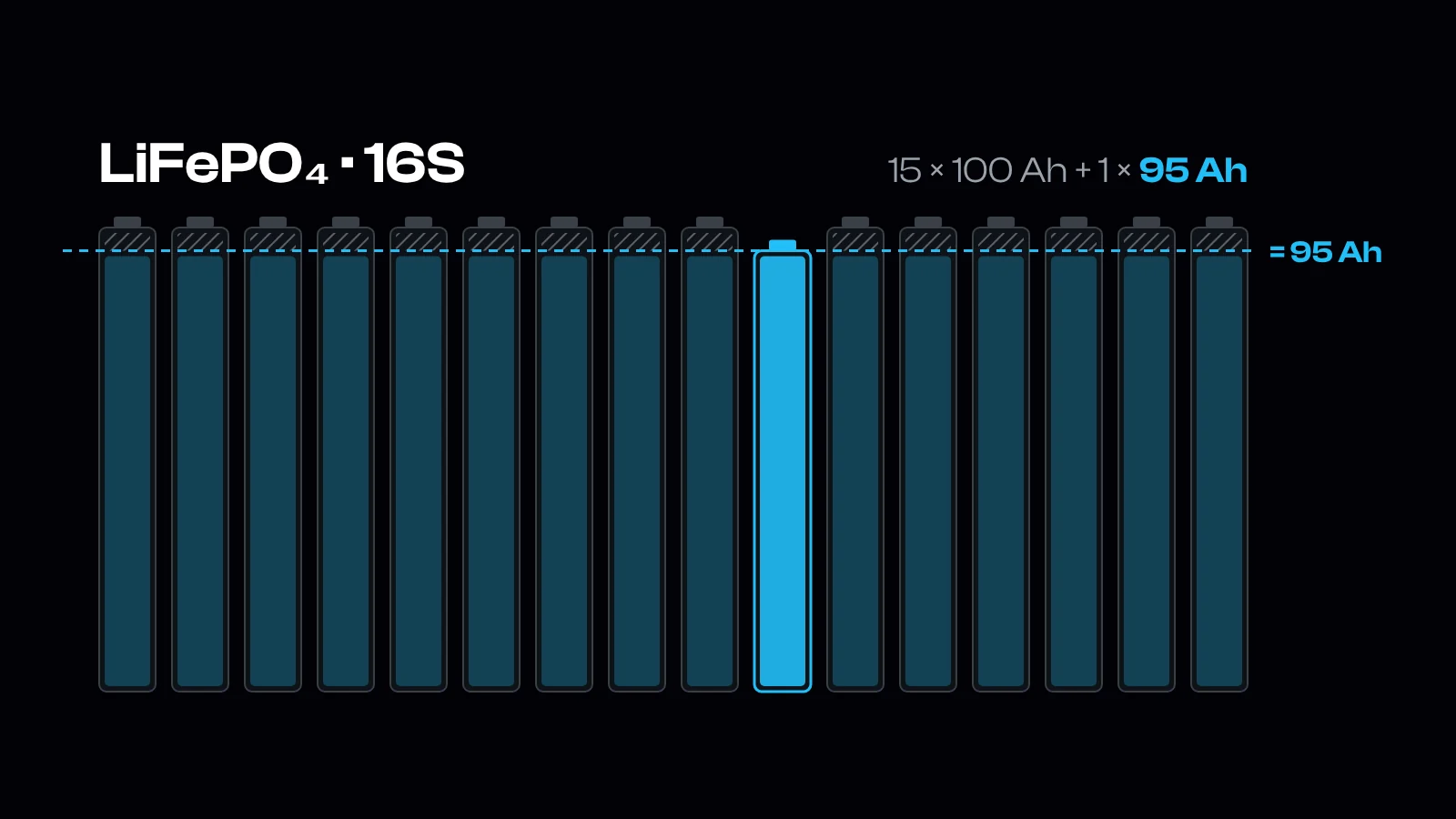
A lithium battery delivers the energy its weakest cell allows. That is why cell consistency matters so much: how similar all the cells in a battery are in capacity, internal resistance, self-discharge, temperature and ageing. The more alike they are, the more usable energy you get every day and the more years the battery lasts.
In this article we explain two concepts you need to understand it (state of charge and resting voltage), why the state of charge is harder to measure in LiFePO₄ batteries, which differences between cells matter and how they are kept under control.
Two concepts first: SOC and OCV
SOC (State of Charge) is the percentage you see on the machine's battery indicator. It works like a car's fuel gauge: a 100 Ah battery at 60% has about 60 Ah available.
OCV (Open Circuit Voltage) is the resting voltage: what a cell reads after it has been neither charging nor discharging for a while. In many chemistries the two are closely linked: measure the resting voltage and you know how much charge is left.
The LiFePO₄ case: the plateau
In lithium iron phosphate cells (LiFePO₄ or LFP), the chemistry we use in all our batteries, that relationship has a peculiarity. The cell works between about 2.5 V (empty) and 3.65 V (end of charge), with a nominal voltage of 3.2 V. But over most of its range, roughly between 20% and 90% charge, the resting voltage barely moves: it changes by less than a tenth of a volt. This is called the plateau of the curve.
In an NMC cell (nickel, manganese and cobalt), by contrast, voltage rises much more steadily with charge: between 20% and 80% it can change by around 0.3 to 0.4 V, so reading the SOC from the voltage is easier.
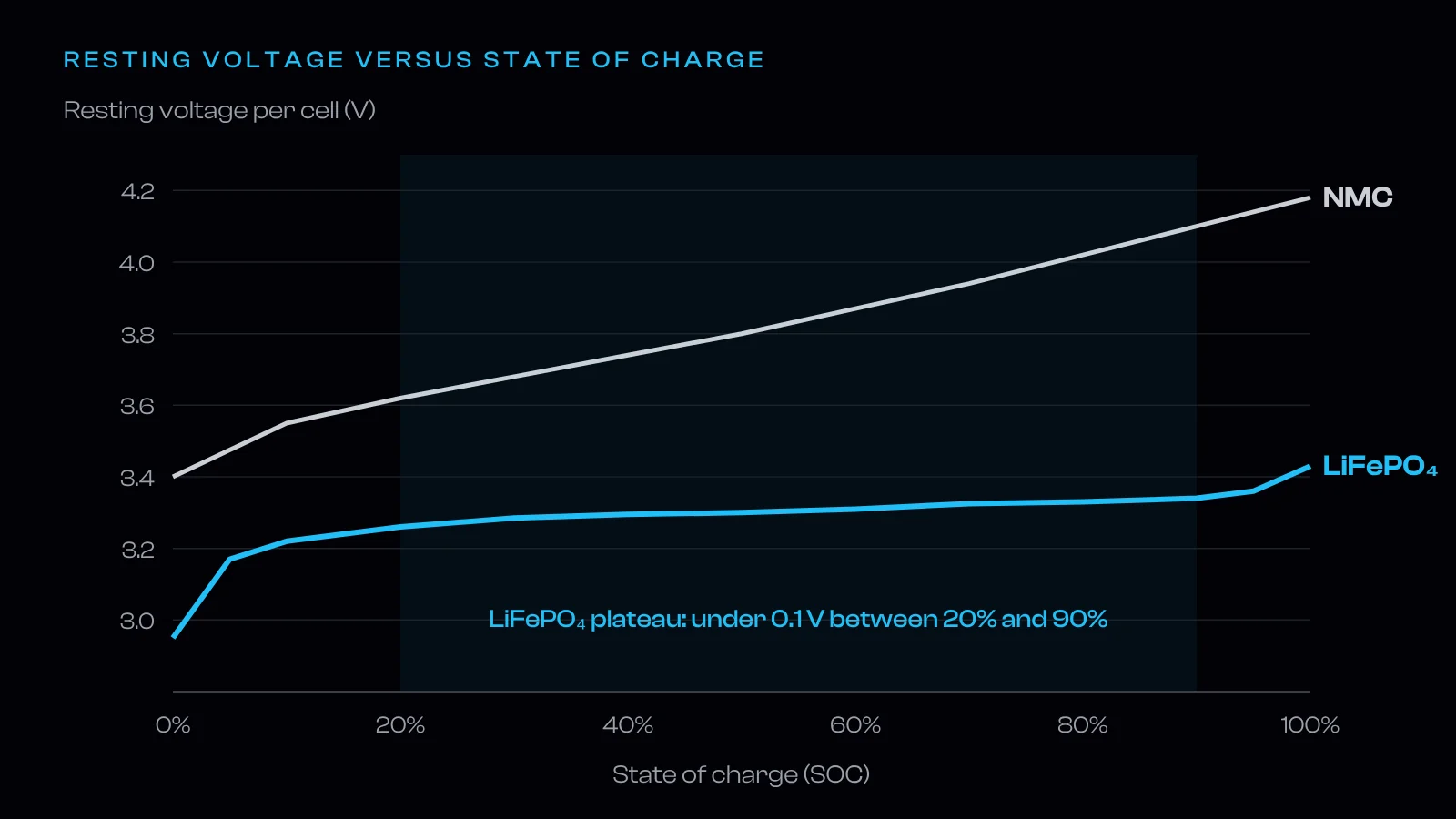
The plateau has a good side and a side that needs managing:
- The good side: LFP voltage stays almost constant throughout the discharge, so the machine has the same power halfway through the shift as at the start.
- The side to manage: voltage alone cannot tell whether the battery is at 40% or 70%. The BMS (the battery management system) has to count the amp-hours going in and out, and correct that count at the ends of the curve, where voltage does change clearly.
That is why many manufacturers recommend completing a full charge to 100% every so often, even if the machine runs on short opportunity charges: the BMS uses that point to recalibrate the indicator. Always follow your battery manufacturer's recommendation.
What it means for cells to be consistent
A 48 V industrial battery has 16 LFP cells in series (16 × 3.2 V = 51.2 V nominal). The same current flows through all of them, so the battery behaves like a group that can only move at the pace of its slowest member.
An example with numbers: if 15 cells have 100 Ah and one has 95 Ah, the whole battery delivers 95 Ah. When that cell is empty, the BMS has to stop the discharge to protect it, even though the other 15 still have 5% of their energy left. Charging works the other way round: that same cell fills up first and forces the charge to stop.
These are the differences that matter:
| Parameter | What it is | What happens if the cells are not alike |
|---|---|---|
| Capacity | The amp-hours each cell can store | The whole battery performs like its lowest-capacity cell |
| Internal resistance | How much the cell opposes the flow of current | The higher-resistance cell runs hotter and loses more energy every cycle |
| Self-discharge | The charge a cell loses at rest | Over weeks, some cells end up lower than others even if the battery is not used |
| Temperature | The heat each cell reaches in use | Hotter cells age faster |
| Ageing | How capacity and resistance change over the cycles | Battery life is set by the cell that ages fastest |
Voltage differences between cells, which is what users usually see in a diagnosis, are the result of everything above.
Why the differences grow over time
Differences between cells tend to widen on their own. A cell with slightly higher internal resistance heats up a little more every cycle. Being hotter, it ages a little faster, and as it ages its resistance rises further. The same happens with capacity: the smallest cell reaches the lower limit first in every discharge, works proportionally deeper and wears out sooner.
Position inside the enclosure also plays a part. A cell in the middle of the block, surrounded by others, gets rid of heat less easily than one next to the wall. If the thermal design does not account for this, the cells in the centre age before the ones at the edges.
How a consistent battery is built
Consistency is worked on at three different stages:
1. When choosing the cells. Cells from the same manufacturer and batch, sorted by capacity, internal resistance, voltage and self-discharge before they are assembled together. This is the foundation: what goes into the battery uneven comes out uneven.
2. When designing the enclosure. A layout that spreads heat evenly and temperature sensors at the points that get hottest.
3. In use. The BMS monitors the voltage of each cell and equalises them through cell balancing.
There is an important nuance about the third point. Balancing equalises the cells' state of charge, but it cannot equalise their capacity or their internal resistance. A 95 Ah cell is still a 95 Ah cell however much the BMS balances it. So balancing is necessary, but it does not replace good cell selection. If you want to see how it works and the difference between passive and active balancing, we explain it in our article on how cell balancing improves battery life.
What to ask before buying a battery
- Where do the cells come from? Are they all from the same batch? Are they sorted before assembly?
- Can I see the voltage of each cell? It is how you spot a cell that is starting to drift from the rest in time.
- What voltage difference between cells does the BMS allow before warning? A good BMS warns before the difference forces the machine to stop.
- When does the BMS balance? Only at the end of charging, or also during discharge?
- How is heat distributed inside the enclosure? Ask where the temperature sensors are.
Consistency at NCPower
We work with LiFePO₄ cells and develop our own BMS. It measures the voltage of each cell and the battery temperature, and balances the cells continuously, during both charging and discharging, so that small differences do not build up cycle after cycle. With remote monitoring you can see the status of each battery from a distance and spot a cell that is drifting before it affects the machine's work.
For an overview of everything a BMS does, see our guide what a BMS is and why it decides the life of your lithium battery.
Where do we start?
Replacing a lead-acid battery? Send us a photo of your current battery's nameplate and we will tell you which lithium battery matches it.
Designing a new vehicle or machine? Tell us how many hours it works, how it charges and at what temperatures, and our engineers will explain how to size the battery and its BMS. You can also ask us for a preliminary consultation.
Write to us from the NCPower contact page and we will get back to you.